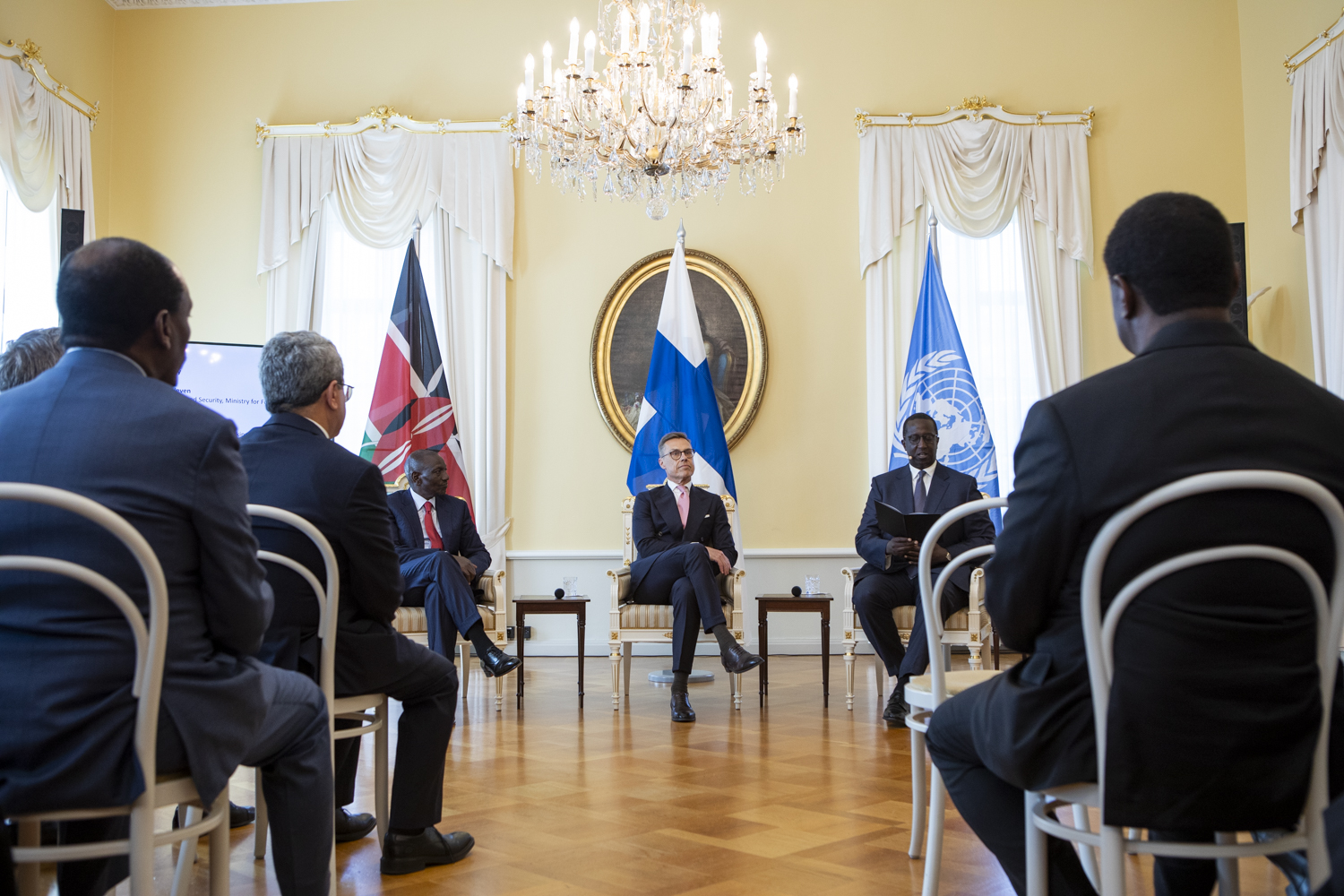
The Government Banquet Hall in Helsinki was packed as guests gathered to hear Finnish President Alexander Stubb and Kenyan President William Ruto discuss the future of the United Nations and the changing global order during a dialogue titled “The Promise of Peace”, hosted by CMI and the Ministry for Foreign Affairs of Finland.
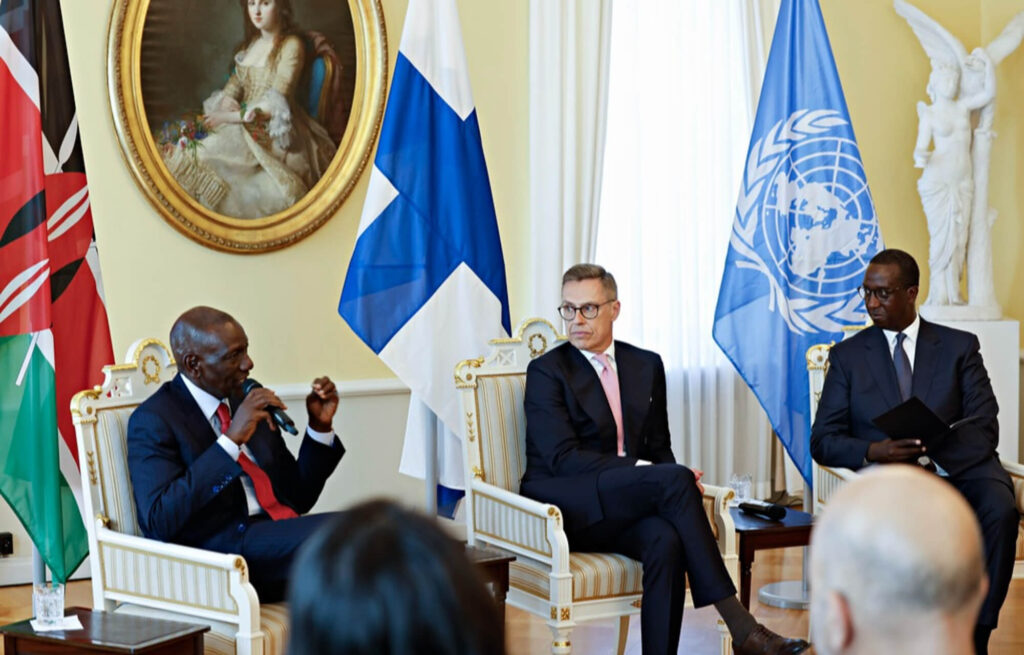
The Ministry for Foreign Affairs of Finland and CMI – Martti Ahtisaari Peace Foundation hosted the presidents during President William Ruto’s state visit to Finland. Itonde Kakoma, President of Interpeace (right), moderated the dialogue. Photo: Jarno Kovamäki/ Office of the President of the Republic of Finland
President of Kenya, William Ruto, and President of Finland, Alexander Stubb, called for reform of the United Nations to better reflect contemporary political realities and power balances during a high-level dialogue entitled “The Promise of Peace”, in Helsinki, Finland, on 10 June 2026.
The presidents agreed that the United Nations continues to be the world’s most important platform for peace and cooperation between nations but warned that its structures are still rooted in the post-1945 order.
Ruto noted that the current system suffers from a serious legitimacy gap as it no longer represents its membership. Africa is a case point, as despite representing 1.5 billion people, the continent remains without a permanent seat on the UN Security Council. He argued that Africa should no longer be treated as a problem to be solved. The continent is a major source of opportunities, with vast human capital, natural resources, renewable energy potential, and a rapidly growing economic market.
Stubb echoed Ruto’s call for reform, adding that the next UN Secretary-General must take greater political initiative and help drive a renewed founding-level effort to reshape global cooperation, preferably in the Global South. To address challenges related to permanence, veto and accountability, the Finnish president proposed expanding the Security Council; redistributing power toward underrepresented regions; challenging the veto system; and giving the General Assembly a stronger role when the Security Council is blocked.
Finally, both leaders emphasised the role of middle powers and regional organisations in shaping the next phase global order. Ruto highlighted Africa’s efforts to reform the African Union and strengthen its voice and the need for Africa to start with addressing challenges at home, while Stubb argued that middle powers and regional integration in the form of organisations like EU, AU, ASEAN, and Mercosur can serve as catalyst for global cooperation. The overall conclusion was that all must take responsibility for building a more responsive, representative and effective multilateral system.
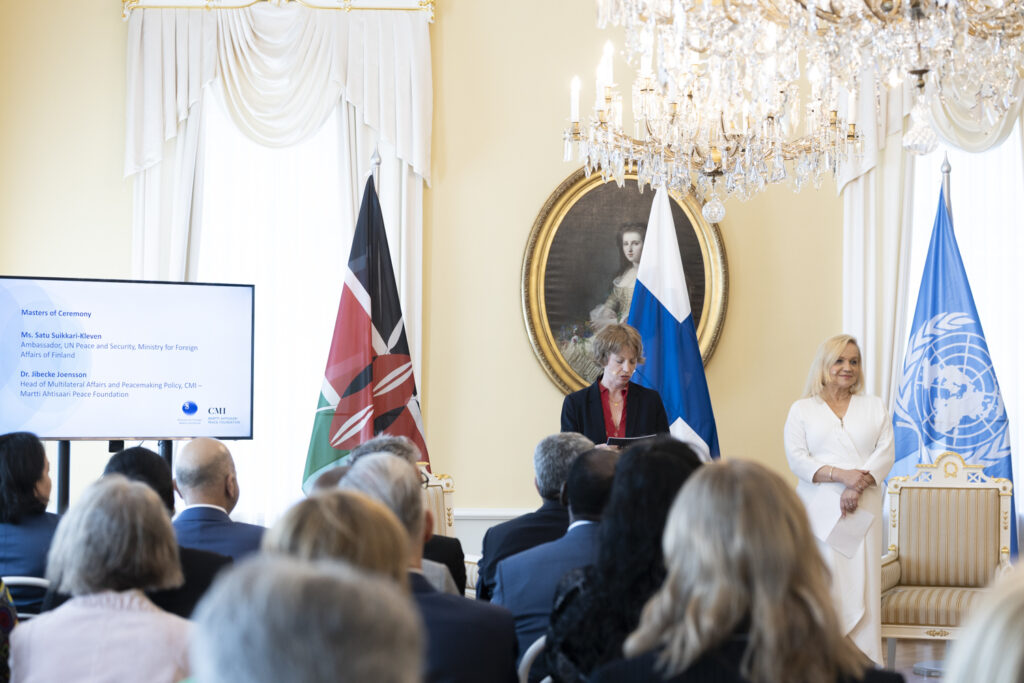
Jibecke Joensson, Head, Multilateral Affairs and Peacemaking Policy at CMI, highlighted that while things are changing, multilateralism still very much matters, but the system needs to adapt, notably to address the discrepancies between politics and institutions, membership and structures, and multipolarity and multilateralism. She underlined that the UN’s added value must be preserved, particularly its convening power, its role as a guarantor for peace, and its position at the centre of global governance, notably to uphold the UN Charter. Joensson also stressed that what the UN needs now is leadership, and for the new UN Secretary-General and member states to take that space, pointing in particular to the potential role of middle powers and regional organisations. Photo: CMI/ Maria Hossain Santto
UN ambassadors call for stronger accountability and broader representation
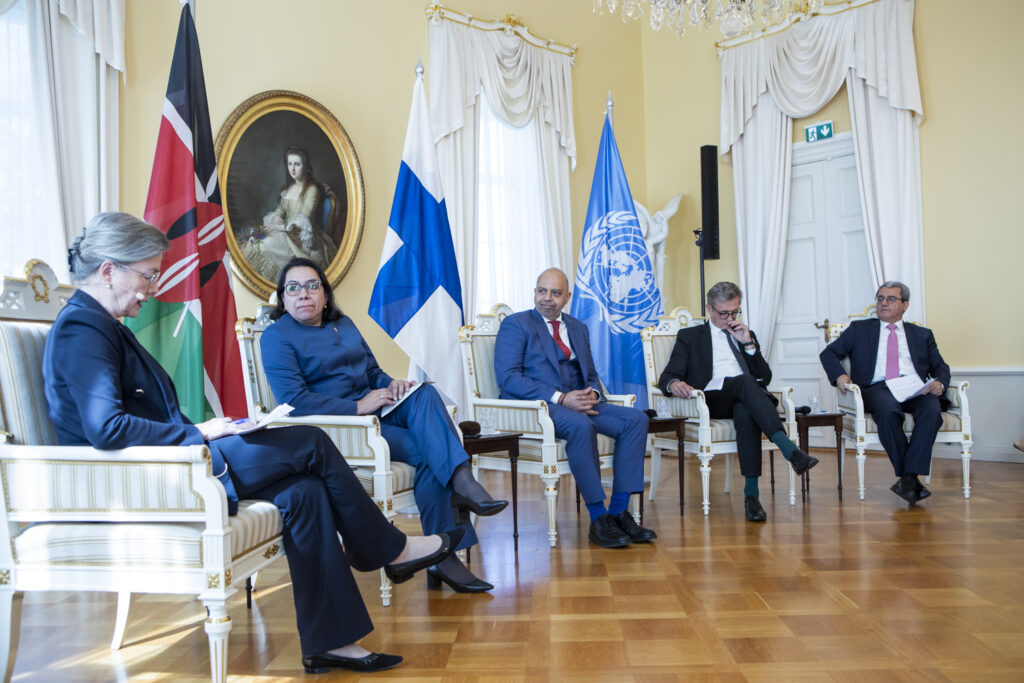
L to R: Elina Kalkku (Finland), Carolyn Rodrigues-Brikett (Guyana), Tareq M. A. M. Albanai (Kuwait), Christian Wenaweser (Liechtenstein), Ahmet Yıldız (Türkiye). Photo: CMI/ Maria Hossain Santto
Following the presidential dialogue, a panel of UN Permanent Representatives from New York examined how the United Nations can remain effective in maintaining international peace and security. Moderated by Finland’s UN Ambassador Elina Kalkku, the discussion brought together ambassadors from Guyana, Kuwait, Liechtenstein, and Türkiye to reflect on the respective roles of the Security Council and the General Assembly, and the importance of dialogue and mediation.
A recurring theme was the growing gap between expectations placed on the UN and its ability to act when major powers disagree. Panellists agreed that national interests and the use of veto powers often prevent the Security Council from acting during major crises. They argued that strengthening accountability and broadening representation would help reinforce the Council’s credibility.
The discussion highlighted the important role played by the elected members of the Security Council, known as the E10. Carolyn Rodrigues-Brikett of Guyana argued that elected members can act as bridge-builders and, when united, provide momentum for action even when permanent members are divided. She emphasised that cooperation among elected members has become increasingly important to strengthen the Council’s effectiveness and ensure that broader UN membership is represented in its work. She also stressed how the Council should not ignore the voices of those most impacted by conflict.
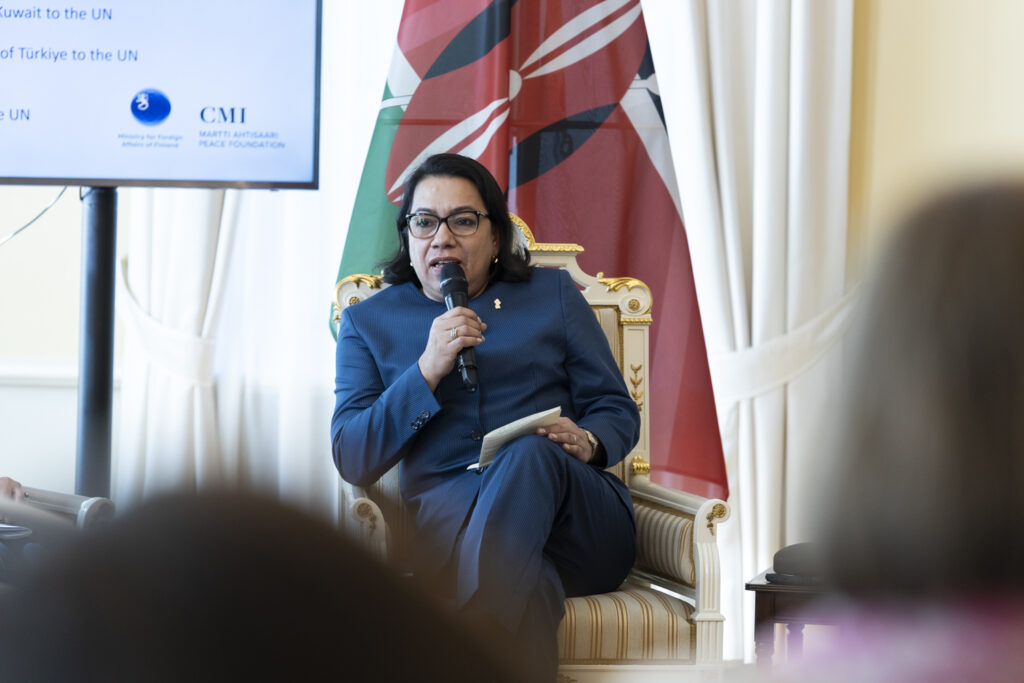
Carolyn Rodrigues-Brikett of Guyana argued that elected members can act as bridge-builders and forge consensus. Photo: CMI/ Maria Hossain Santto
Much of the conversation focused on how the UN system could better reflect contemporary realities. Kuwait’s representative Tareq M. A. M. Albanai outlined the challenges of Security Council reform, arguing that the current structures lack sufficient representativeness and accountability. He suggested exploring a new category of longer-term elected members to give regions such as Africa, Latin America, and Asia a stronger voice in the Council.
Another key theme was the role of the General Assembly in responding when the Security Council is unable to act. Liechtenstein’s Christian Wenaweser argued that the wider UN membership should play a stronger role in holding the Council accountable. He pointed to an initiative that would automatically bring Security Council vetoes to the General Assembly as a measure of accountability that strengthens the role of the wider UN membership. He also encouraged the building of new alliances that would move away from the (false) North-South divide.
Looking ahead, the role of prevention and mediation were regarded essential. Türkiye’s Permanent Representative Ahmet Yıldız, who is also co-chair of the UN Group of Friends of Mediation together with Finland’s Elina Kalkku, emphasised that preventing conflicts before they escalate should remain a central objective of the UN. He also highlighted the role that regional organisations can play because they often possess capacity that can complement UN efforts.
Five Conclusions for the UN’s Future
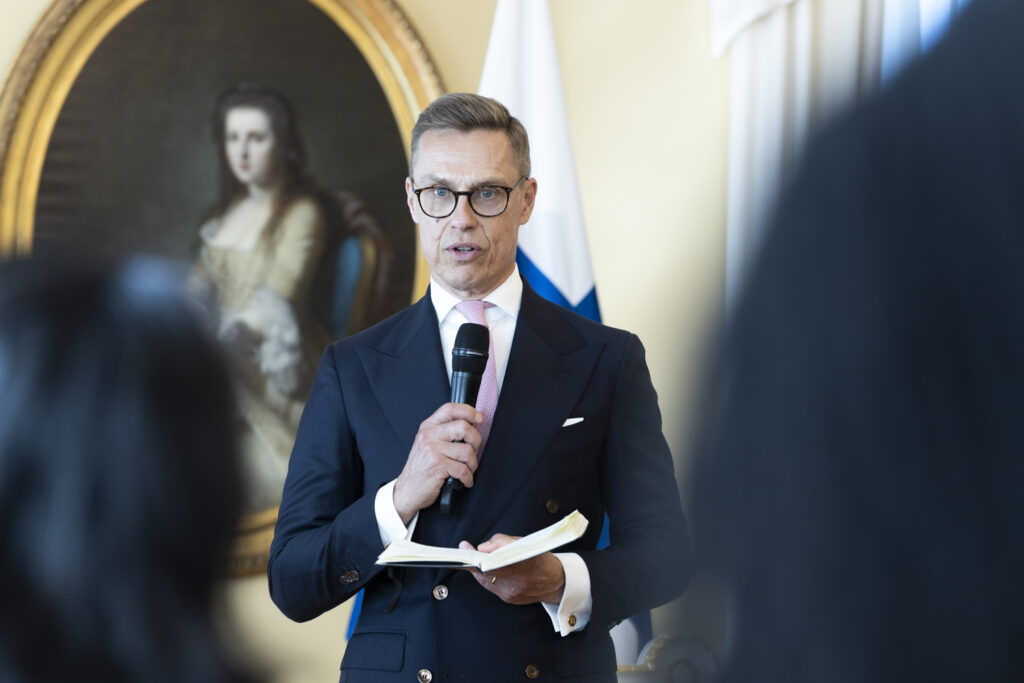
Photo: CMI/ Maria Hossain Santto
As the event drew to a close, President Stubb outlined five conclusions he takes with him. First, the UN needs reform to preserve its three equally important pillars: peace, development and human rights. Second, the issues the UN Security Council needs to address are threefold: permanent seats, the veto, and accountability. Third, there is a need for a renewed founding-level effort to reshape global cooperation, with the Global South taking the lead. Fourth, the Secretary-General’s agenda should be used to change things and to initiate new actions. Finally, he noted that Finland, if elected to the UN Security Council, can bring change.
The event was organised by the Ministry for Foreign Affairs of Finland and CMI – Martti Ahtisaari Peace Foundation in Helsinki on 10 June 2026 as part of President William Ruto’s state visit to Finland.