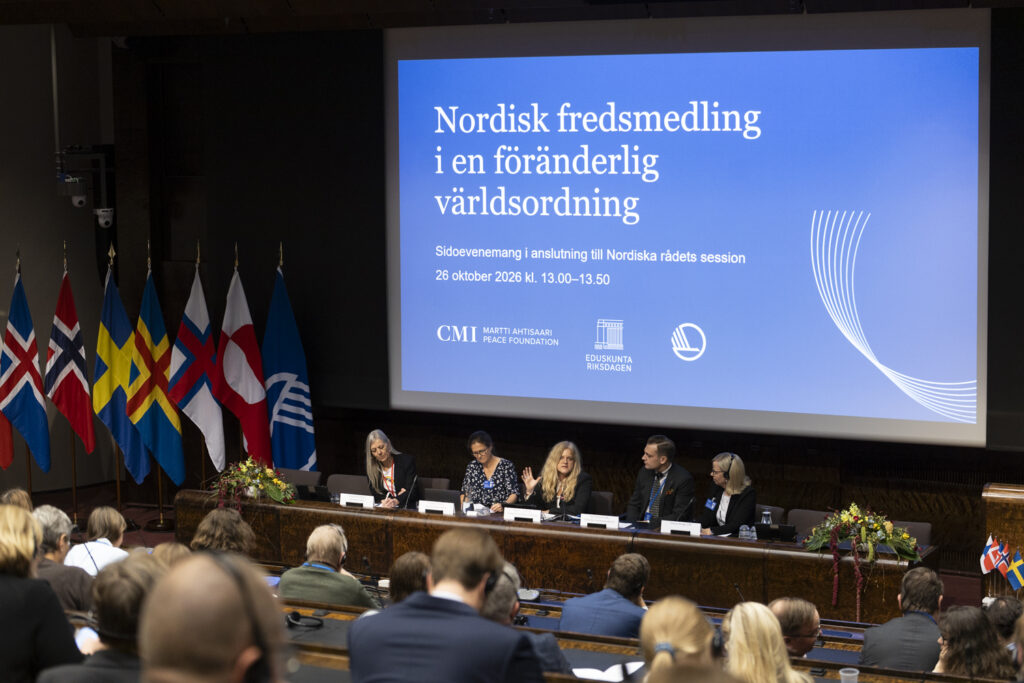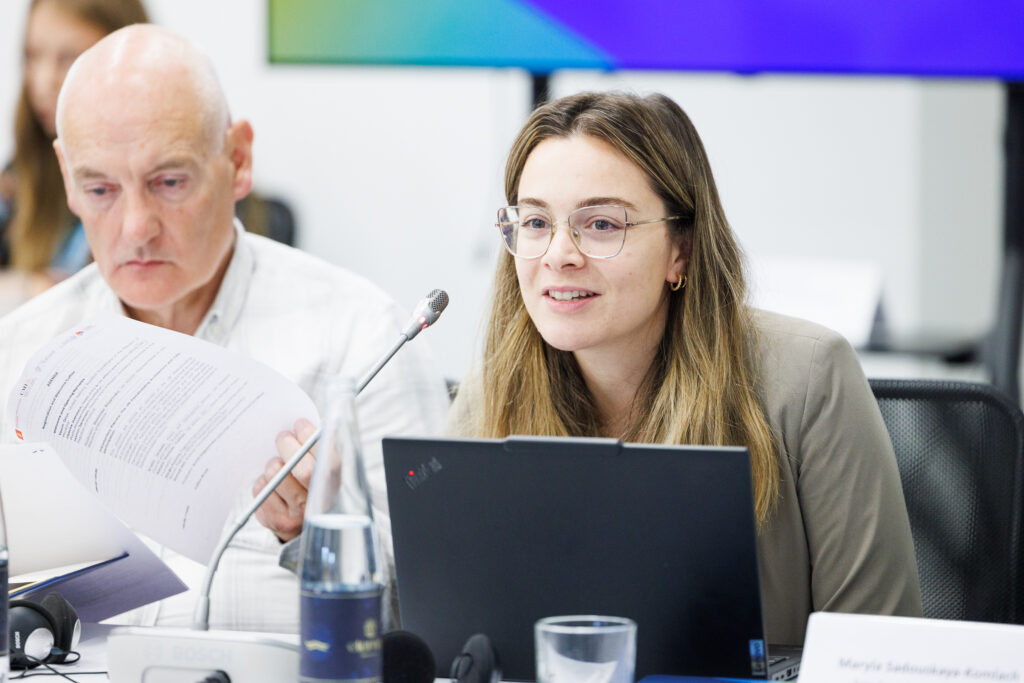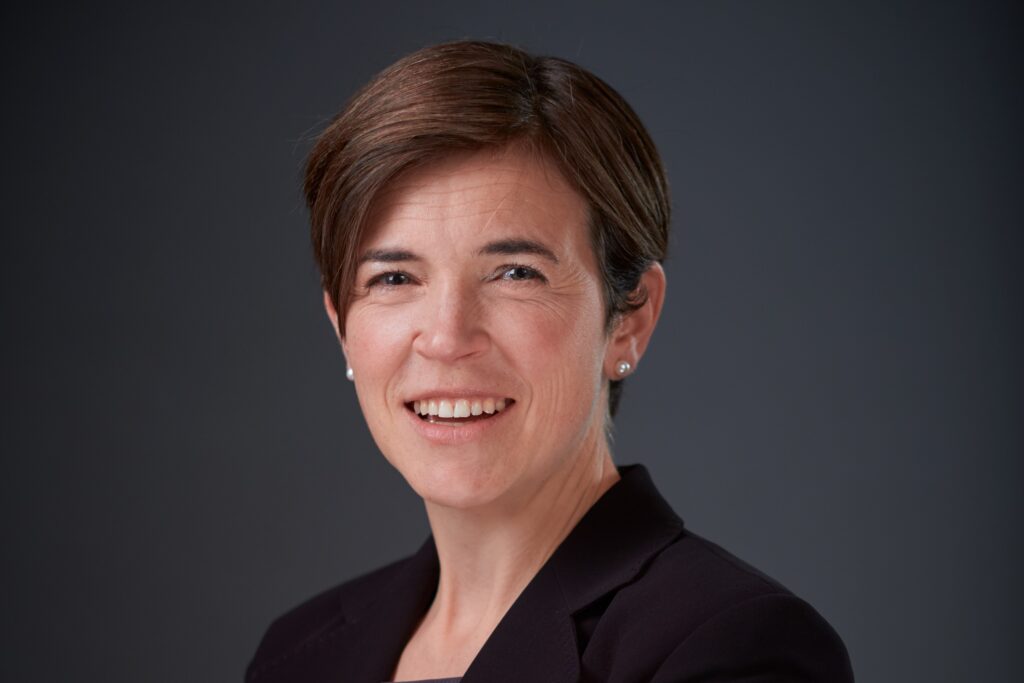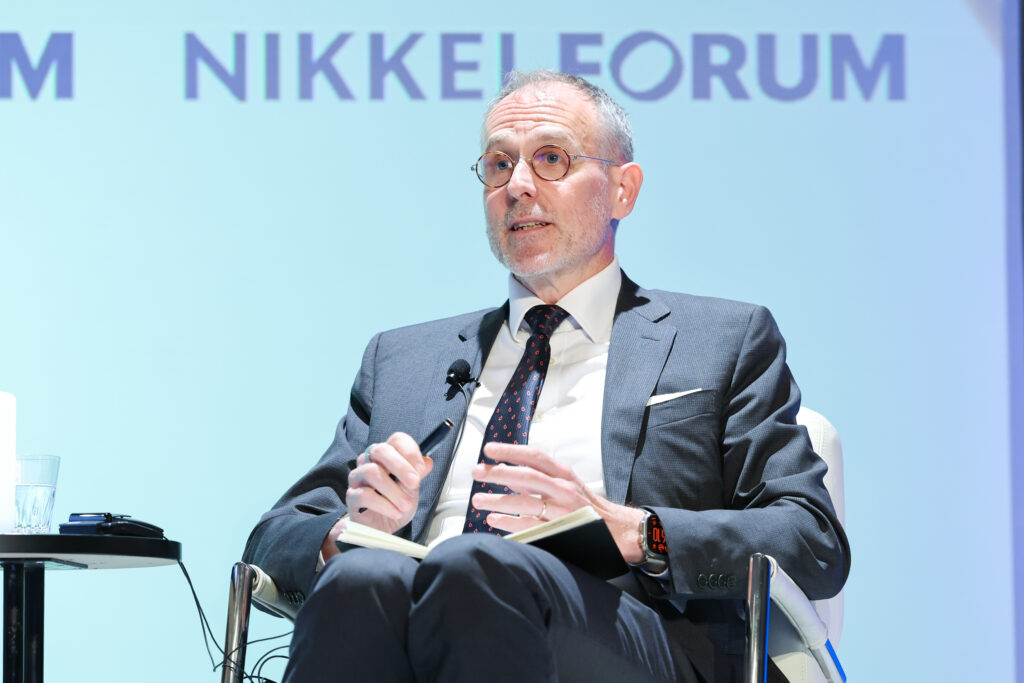
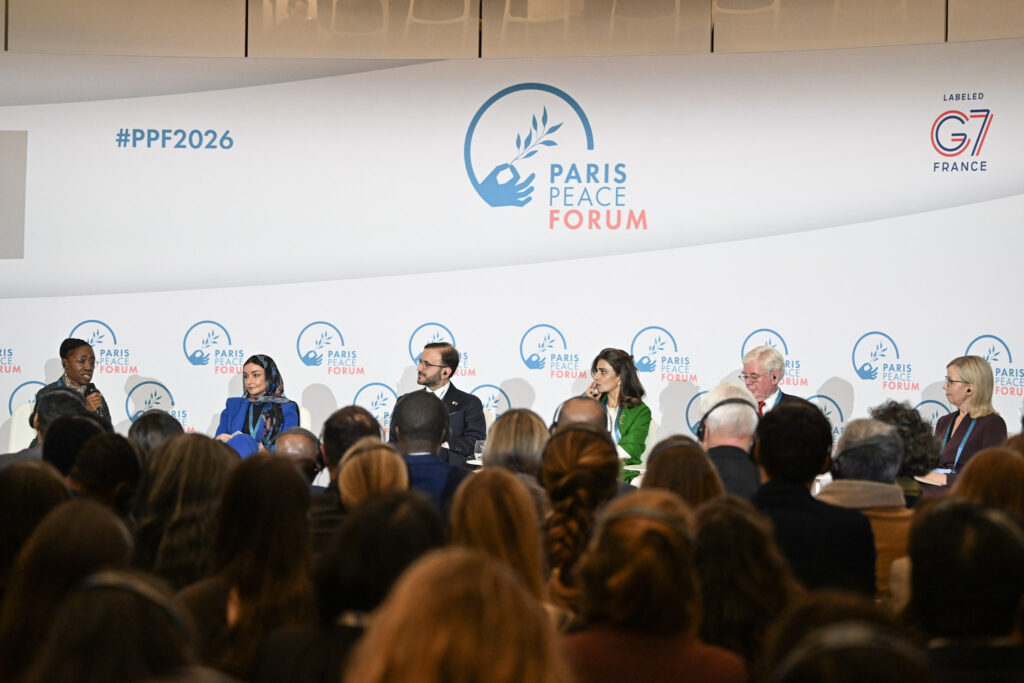
CMI – Martti Ahtisaari Peace Foundation participated in the Paris Peace Forum last week for discussions on the changing role of peace mediation and cooperation between states, regional organisations and private diplomacy actors.
The two-day forum, ‘From Sovereignty to Cooperation’, brought together government officials, ministers, heads of state, and representatives of international organisations, think tanks, NGOs and the private sector. CMI attended at the invitation of the European Commission’s Service for Foreign Policy Instruments (FPI).
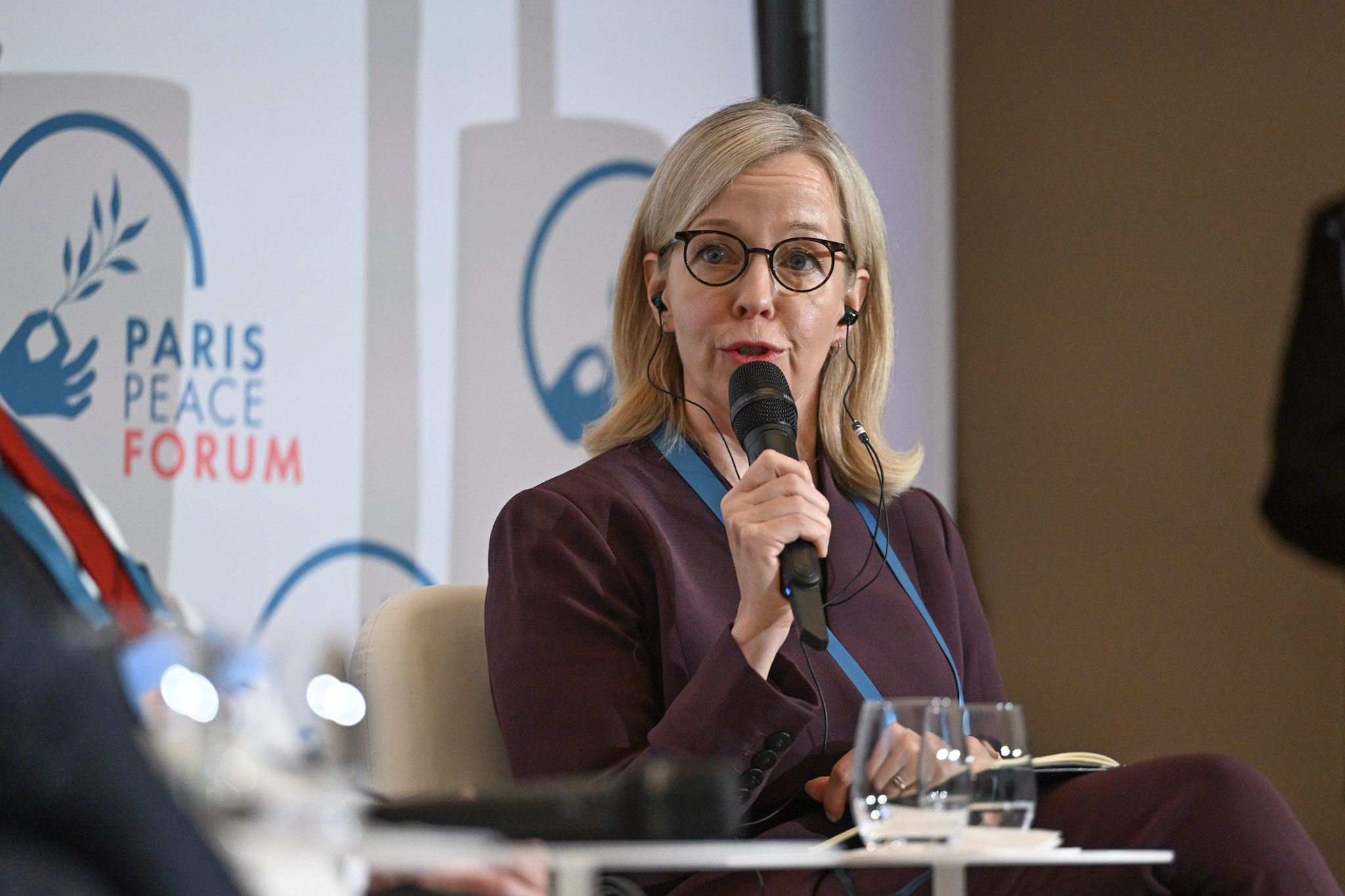
CMI’s Acting CEO Hanna Klinge spoke on the panel, Peace Mediation Today: New Actors, New Coalitions, Lasting Results, which examined how different mediation actors can combine their strengths in efforts to achieve sustainable peace. Klinge said that it was important that roles were clarified and she championed complementarity, highlighting the contribution of private diplomacy actors in bridging different actors, processes and mediation tracks.
For CMI’s Jibecke Joensson, Head of Multilateral Affairs and Peacemaking Policy, one of the aspects that stood out from the discussions was the focus on the “somewhat paradoxical need to at the same time build coalitions and cooperation frameworks, while strengthening sovereignty and strategic autonomy.”
Much of the discussion, she said, concerned the need to redefine existing principles, concepts, models and tools in response to what many practitioners and scholars are calling a faltering international order. Joensson also observed that there was considerable attention given to middle powers and what many call ‘new actors’, geoeconomics and the balance between diplomacy and deterrence.
Among other prominent attendees was Christine Lagarde, President of the European Central Bank, who said that Europe faced the challenge of strengthening economic independence, while maintaining openness and international cooperation.
Lagarde said that Europe’s collective economic strength enabled it to reduce its vulnerability to external pressure. She warned that Europe relied too heavily on companies outside the continent in strategically important areas, such as artificial intelligence. But at the same time, cautioned against turning too inwards and away from strategic partners. The answer, she said, lies in Europe acting together, with a view to achieving indispensability through innovation.
New actors and coalitions in peace mediation
CMI’s Acting CEO Hanna Klinge was joined in her discussion by Majed Al-Ansari, Advisor to the Prime Minister of Qatar and Official Spokesperson for the Ministry of Foreign Affairs, who argued that mediation was a “necessity” rather than a choice for Qatar.
Qatar and other small and middle-power states have become “driving states”, he said, wherein they respond to regional threats and risks as well as global shifts. Al-Ansari described Qatar’s approach as part of building a “supply chain for peace”, in which different partners play specific roles that complement one another.
Manal Radwan, Advisor to the Special Envoy to Saudi Arabia’s Minister of Foreign Affairs for Negotiations and Peace Efforts, characterised the international system as broken and called for change. She highlighted the “unprecedented interconnectivity of conflicts” and described how regional security arrangements have emerged out of necessity. But there must be complementarity across different mediation efforts, said Radwan.
Acting CMI CEO Hanna Klinge spoke on the panel, Peace Mediation Today: New Actors, New Coalitions, Lasting Results. Photo: Emma Da Silva.
This rupture of international norms was also central to the remarks of Hina Rabbani Khar, a fellow panellist and Chair of Pakistan’s National Assembly Committee on Foreign Affairs and former Foreign Minister. She spoke of an unprecedented number of “wars of choice” and argued that countries must find ways to engage with actors they do not like.
Pakistan, she said, has sought to create spaces where actors can develop empathy for one another’s views. She added: It’s important to find enough common ground to enable engagement. Contact is important, even when substantial disagreements remain.
Eamon Gilmore, Senior Adviser at the European Institute of Peace, drew from Colombia. He noted that the peace process took 25 years from first talks to final agreement and remains a work in progress. Northern Ireland’s peace process also took decades, he said.
In Colombia, numerous countries and multilateral organisations were involved, Gilmore said, and the process was “Colombian-owned”. He questioned the emphasis placed on individual mediators, arguing that what matters is how to stop the fighting and whether peace is sustainable. He stressed that clearer political commitment beyond quick fixes is needed.
From Acting CEO Klinge’s perspective, private diplomacy actors can help bring together different actors and processes and, where useful, also different mediation tracks. “Much of CMI’s work takes place discreetly,” she explained, “behind the scenes and away from the spotlight”.
Women and young people in mediation
In Building Resilience with a New Generation of Women Peace Mediators, Asaaska Labarakwe, Technical Advisor on Peace and Security Diplomacy at Kenya’s Ministry of Foreign and Diaspora Affairs, made a familiar point: that inclusion should move from being an afterthought to a strategic necessity.
Young people possess competencies that cannot be overlooked or replaced, she said. Moreover, a new generation of women mediators is not waiting for a place at the table but reshaping it. Labarakwe called for transformative rather than transactional mediation gains.
Fatima Maiga, a member of the International Network of Francophone Women Mediators said that traditional mediation training does not necessarily equip practitioners with the language needed to mediate across societies today. Drawing on the experience of youth mobilisation in Mali, Maiga described how younger generations have used faster and more widely reaching tools to mobilise mediation efforts. Some of their main concerns include justice, violence against women, employment and income, she said.
Maiga also cautioned that complementarity cannot substitute for long-term work and commitment. Mediators being able to combine their respective strengths does not remove the need for sustained engagement, she said.
Political commitment and the limits of diplomacy
The question of political leverage was prominent in Is Peace in Sudan Still Possible? Putting Civilians at the Center of the Process, at which former UK Foreign Secretary and President of the International Rescue Committee, David Miliband, was a panellist.
Miliband argued that Sudan is a priority for those funding violence, while those supporting diplomacy are not paying the same attention to the conflict. In his view, violent parties are operating with much greater strength than diplomatic efforts.
Diplomacy without power is like music without instruments, he said. Existing mediation initiatives need greater leverage if they are to influence the parties and the external actors sustaining the conflict.
Mo Ibrahim, Founder and Chair of the Mo Ibrahim Foundation, was sharply critical of the continued supply of weapons to the parties. He said that 11 countries were supplying arms and he called for sanctions, arguing that diplomatic initiatives could achieve little while the flow of weapons continued.
Ibrahim also warned about the wider regional consequences of the conflict, describing an expanding area of ungoverned territory stretching from the Sahel towards the Red Sea. He criticised the lack of attention being paid to the region by Europe and the United States.
Luca Miehe, Head of Cabinet at the Office of the EU Special Representative for the Horn of Africa, offered a different perspective on the possibilities for diplomatic engagement. He pointed to the work of the Quintet, a unique format bringing together five multilateral organisations, and added that there were opportunities to make better use of existing formats. Cooperation between the organisations is complicated, he said, but has enabled them to connect actors, build bridges and facilitate discussions.
Building coalitions for international cooperation
The role of middle powers was explored in Building a Coalition for International Cooperation: Principles for a Shared Future, where representatives from Canada, the Netherlands and Brazil discussed new approaches to cooperation in a changing international order.
Shawn Steil, Director General, Strategy, at Global Affairs Canada, said that Canada’s renewed focus on sovereignty and strategic capabilities is taking place alongside efforts to build new international coalitions. Steil made the point that coalitions can be based on converging interests and complementary capabilities, without requiring agreement on every issue.
Meanwhile, the gap between international commitments and their implementation was highlighted by Mauricio Favero, Head of the Special Office for Diplomatic Planning at Brazil’s Ministry of Foreign Affairs. Countries have collectively agreed mandates and are forming coalitions around common agendas, but these have not yet been matched by sufficient resources, he said.
For Favero, middle powers have an important role in strengthening international cooperation, particularly as major powers disengage from or reduce their support for the international system.
Reflecting on the forum, Joensson welcomed the fact that discussions were “starting to move beyond going over the past and present – a broken world order – and were instead looking into the future, to reimagine cooperation models and organisations.”