As traditional power structures shift and multilateral institutions face unprecedented strain, the need for connectivity in mediation has never been more urgent.
The multilateral system, once the backbone of global peacemaking, is under pressure, with polarisation, transactional diplomacy, and the rise of new centres of influence challenging commonly agreed rules and norms. As a result, peace mediation has become increasingly fragmented and transient, and thus more coordination, collaboration and connectivity is urgently required.
In response to the new volatile normal, CMI updated its strategy in 2025 to commit additional resources to ‘bridging gaps and strengthening multilateralism’. To achieve this, said the strategy, CMI would “redouble efforts to strengthen networks and foster connections with key global and regional peacemaking actors” over the next five years.
Read more:
Peace as a power play: mediation in an era of disorder
Mediation is no longer a largely technical exercise focused on fragile states, but has become a very visible arena of power politics.
CMI has always strived for connectivity. It is a component of its ethos of ‘complementarity‘– at the core of the strategy – which means emphasising engagement, coordination and collaboration with all relevant international, state, regional, and civil society actors.
But the importance of being connected and cooperative has increased in recent years as peace mediation has in part become a contested arena in global power politics with changing alignments and emergence of new peace and security actors.
By continuously assessing where, how and by whom mediation and dialogue efforts are carried out, CMI can remain connected and ensure that its work stays relevant and effective.
Exchange supports connectivity
Particularly in this moment of uncertainty and flux, CMI aims to foster and strengthen mutual understanding and cooperation among mediators globally.
This takes the form of dialogues and exchanges on mediation approaches and methodologies, cooperation models and complementarities in conflict contexts. Discussions may be thematic or context-specific in nature – with the aim of improved collective mediation efforts.
CMI’s participation in international and regional fora, provision of tailored training and expert exchanges with relevant national actors are also key components of this connectivity strategy. The foundation is also well positioned to facilitate exchanges on regional cooperation efforts, notably from a Nordic or European standpoint. but also through its longstanding cooperation with regional organisations. Especially as regional conflict prevention and resolution capacities and efforts become increasingly important.
Read more:
The Antalya Diplomacy Forum: “A key node for mediation” says CMI’s CEO
CMI’s CEO says the Antalya Diplomacy Forum has quickly established itself as a “key node for mediation” as it highlights emerging partnerships in international peace mediation.
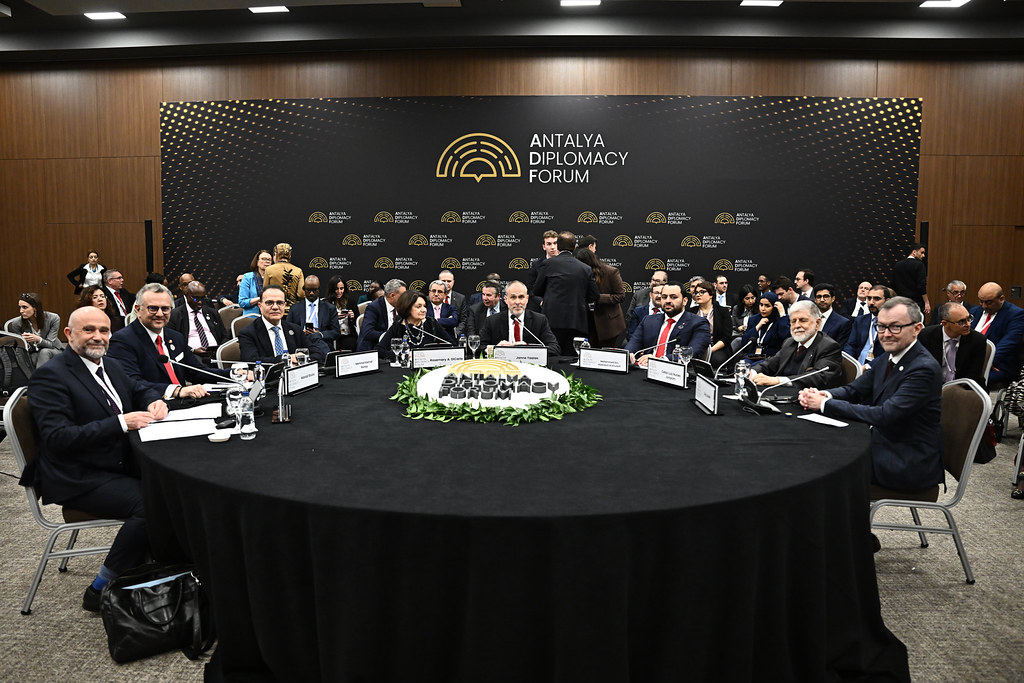
CMI’s CEO, Ambassador Dr. Janne Taalas (centre), moderates a panel at the Antalya Diplomacy Forum 2026. Participating in fora like this is one way for CMI to stay connected and ensure that its work stays relevant and effective. Photo: Orhan Çiçek, Anadolu Agency.
Supporting multilateral actors and dialogue processes
Another critical component of connectivity is CMI’s active support of multilateral actors whose role is “pivotal but undermined”, as CMI’s revised Strategy 2030 puts it.
CMI has intensified its efforts to reinforce partnerships with multilateral organisations, with special attention given to the UN, AU, OSCE, ASEAN, ECOWAS and IGAD, alongside traditional European partners. CMI’s approach is to support regional organisations in assuming a stronger role in international peacemaking.
As part of its mediation connectivity work, CMI also continues to engage with middle powers and regional coalitions, some of whom have been diplomatically active for decades, but whose influence is now growing because of the changing global landscape. Moreover, new powers will continue to emerge as forces on the political stage, including states, private companies, movements, and regional alliances.
With the architecture of global peace and security facing pressure for readjustments, it demands clarity in the roles and mandates of mediators, and more attention on cooperation.
Read more:
How CMI’s partnership with the EU has evolved as peacemaking has shifted
CMI’s strengthened commitment to the EU comes on the back of CMI’s strategy updated, which put connectivity with peacemaking actors, multilateralism and policy at its heart.
Connectivity: a guiding principle since the beginning
With these developments, coordination of informal dialogue and mediation support has become both “more critical and more challenging” for CMI and other independent actors, precipating increased emphasis on connectivity.
Connectivity is at the heart of the informal dialogue process, with CMI creating spaces for conflict parties and other relevant societal actors to build trust and explore possible solutions together. The results of the dialogues then feed into or prepare the way for formal processes.
Mediation support, similarly, stems from trusted relationships and the specific needs of leading mediation actors. CMI may provide technical or context-specific expertise, secretariat support, exchanges on lessons learned, or training.
CMI has a track-record of independent dialogue and mediation support work across regional and thematic programmes stretching back 25 years. Well-established networks and ingrained knowledge of local contexts and actors are cornerstones of sustainable peacemaking.
The deepening emphasis on mediation connectivity signals CMI’s continued commitment to reach out across the diversifying mediation field, build relationships based on mutual learning and explore complementarities, at a time of unprecedented uncertainty and strain on the multilateral system and with the aim of contributing to more effective peacemaking.
Connectivity: How will CMI bridge gaps and strengthen multilateralism?
- Remain steadfast in support of multilateral organisations and solutions
- Redouble efforts to bolster networks and connections with peacemaking actors
- Support regional organisations in assuming a stronger role in international peacemaking
- Strengthen relations with traditional European partners
- Seek deeper engagement with middle powers and regional coalitions
- Promote informal connections with regional and international initiatives
- Build operational partnerships between peacemaking organisations and local actors
- Create spaces for exchange on different peacemaking approaches and methodologies
- Foster cooperation in specific contexts where goals are aligned
- Increase collaboration with the research community and links to academia