CMI – Martti Ahtisaari Peace Foundation and the ASEAN Institute for Peace and Reconciliation organised an introductory training on conflict analysis and conflict resolution in Jakarta, Indonesia, on 3–5 June 2026.
The three-day programme brought together 28 officials and representatives from ASEAN Member States, ASEAN Secretariat, various ASEAN entities, the ASEAN Women for Peace Registry and the ASEAN-IPR Advisory Board. It aimed to strengthen participants’ understanding of conflict analysis, conflict resolution, mediation and dialogue processes.
The training was the second organised jointly by ASEAN Institute for Peace and Reconciliation (ASEAN-IPR) and CMI. The first iteration took place at the ASEAN Secretariat in Jakarta in November 2025. The 2026 programme was supported by the Norwegian Ministry of Foreign Affairs.
ASEAN:
The Association of Southeast Asian Nations was founded in 1967 to promote regional cooperation and stability. The organisation focuses on political-security, economic, and socio-cultural cooperation and has 11 member states across Southeast Asia. ASEAN operates through consensus, non-interference and respects the sovereignty of its members.
Opening the training, ASEAN-IPR Executive Director I Gusti Agung Wesaka Puja emphasised the importance of careful analysis when responding to conflict. “There is no one-size-fits-all solution to conflict, and effective conflict analysis is crucial to solving the problem halfway.”
He also highlighted the need to equip officials from the ASEAN Secretariat, Member States and ASEAN bodies with the knowledge and skills required to conduct in-depth analysis of emerging regional and global challenges.
The programme began with an introduction online on 29 May 2026. The session introduced the wider training programme and included discussions on regional and global peace mechanisms. Participants then met in Jakarta for the in-person part of the programme in the first week of June.
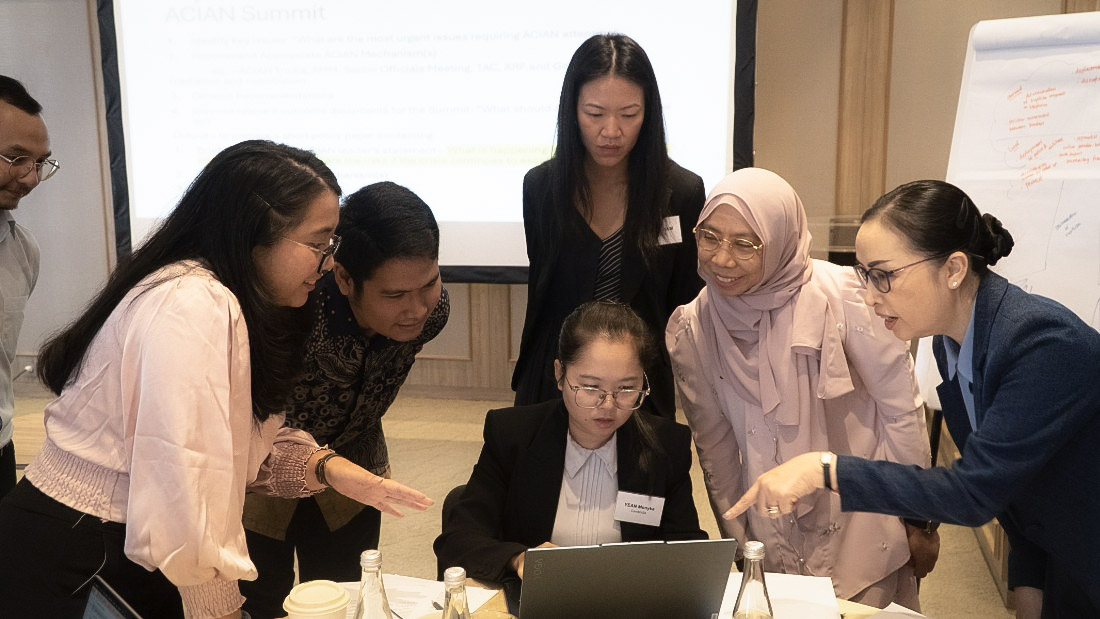
Sessions in Jakarta combined theoretical frameworks, practical exercises and discussions relevant to Southeast Asia. They covered the regional and global peace and security landscape, conflict analysis and assessment methods, negotiation, mediation and dialogue processes.
“There is no one-size-fits-all solution to conflict, and effective conflict analysis is crucial to solving the problem halfway” – I Gusti Agung Wesaka Puja
Participants examined the strengths and limitations of different peacebuilding approaches. Gender-sensitive perspectives were incorporated throughout the programme, reflecting the importance of inclusive approaches to conflict prevention and resolution.
Participants also took part in a scenario-based simulation and case study tailored to the ASEAN context. The exercise focused on conflict prevention, management and resolution. Participants came up with recommendations and deliberated over approaches that ASEAN and its Member States could use when responding to emerging regional challenges and conflicts.
Minna Kukkonen-Karlander, Senior Manager in CMI’s Asia team, highlighted the increasingly important role of regional organisations in conflict resolution amid changes in the international landscape. She also underlined the value of partnerships and capacity-building initiatives for strengthening regional capacities related to dialogue, cooperation and peaceful conflict resolution.
The training concluded with the signing of a Memorandum of Understanding between ASEAN-IPR and CMI. The agreement reaffirmed the organisations’ shared commitment to promoting a culture of peace and strengthening their partnership. It is expected to support future joint activities and further cooperation in peacebuilding, conflict prevention and conflict resolution.