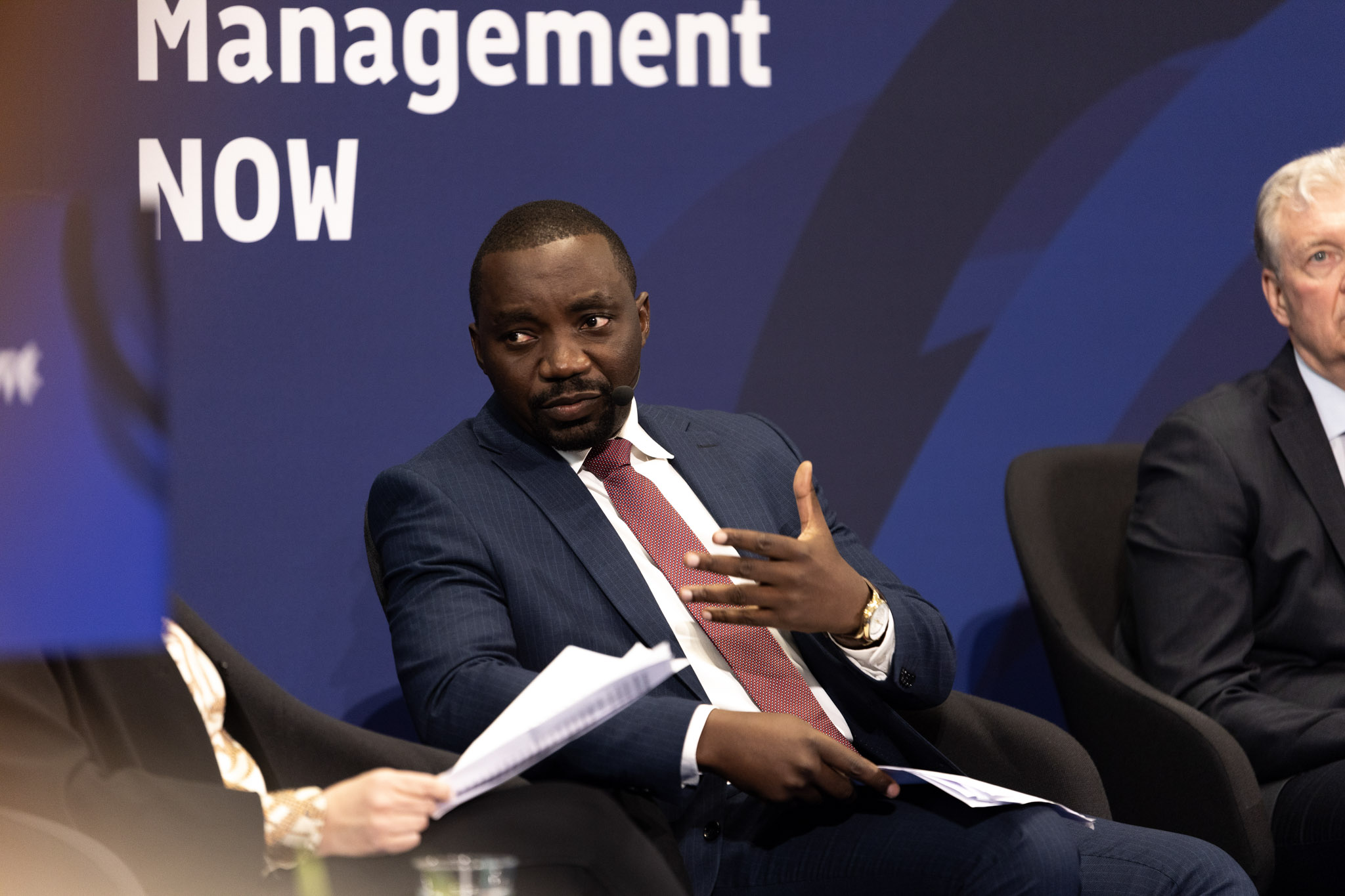
Speaking at Finland’s Crisis Management NOW event to mark 70 years of engagement in international crisis management, CMI advisor Vianney Bisimwa warned that global geopolitical competition is deepening local conflicts and weakening efforts to build sustainable peace.
CMI’s advisor for the Great Lakes region, Vianney Bisimwa, says crisis management efforts are expanding around the world, but genuine crisis resolution is becoming “more distant, more fragile, and harder to sustain”.
In Helsinki to speak about the challenges of global crisis management, Bisimwa – who has extensive experience across a range of contexts in Africa – argued that international responses are becoming increasingly tactical and securitised, while political solutions are being neglected.
“We are responding more, intervening more, spending more, and deploying more tools, yet peace is becoming more distant,” Bisimwa said. “We are trying to contain fires, but not addressing what keeps igniting them.”
International responses are becoming increasingly tactical and securitised, while political solutions are being neglected. – Vianney Bisimwa
Drawing on examples from the Eastern Democratic Republic of the Congo and the Sahel, Bisimwa said military force has increasingly become the default language of crisis management, often without credible political frameworks or mediation efforts behind it.
“In the Sahel, military operations have multiplied, but insecurity has spread,” he said. In Eastern DRC, repeated military offensives have failed to address “structural exclusion, land and identity conflicts, weak governance, regional rivalries, and elite competition over resources and power”.
He added: “These are political problems. Political crises cannot be sustainably resolved by military means alone.”
Bisimwa stressed that mediation, trust-building and sustained political dialogue must remain central to crisis management efforts. He said the mediation philosophy of CMI – Martti Ahtisaari Peace Foundation continues to show the importance of “serious mediation, discreet diplomacy, trust-building, and sustained political dialogue.
“These are not secondary tools; they are central crisis management tools.”
He also warned that crisis management institutions are under growing strain at global, regional and local levels. According to Bisimwa, divisions within the United Nations system, fragmentation within regional organisations, and widening legitimacy deficits at national level are weakening international responses to conflict. At the same time, local peace actors are often excluded from formal crisis management structures.
Mediation, trust-building and sustained political dialogue must remain central to crisis management efforts. – Vianney Bisimwa
“Traditional authorities, customary justice systems, women peacebuilders, youth movements, faith leaders, and indigenous reconciliation mechanisms continue to try to play stabilising roles, but are rarely integrated seriously into crisis architecture,” he said.
Bisimwa argued that many peace processes remain too elite-driven and fail to include communities directly affected by conflict. He said this produces “agreements without ownership” and “peace without roots”.
One of the strongest risks facing global crisis management, he said, is the rise of transactional politics and geopolitical competition. “Too often, responses are increasingly shaped by mineral interests, commercial access, migration politics, military positioning, geopolitical competition,” Bisimwa said.
“The result: short-term deals, elite bargains, and security arrangements built around power, not legitimacy.”
He added that global power competition is now directly influencing local conflicts in places such as the Sahel, Eastern DRC, Sudan and Somalia, creating “shallow peace and deeper instability”.
One of the strongest risks facing global crisis management is the rise of transactional politics and geopolitical competition. – Vianney Bisimwa
Bisimwa also highlighted the growing impact of misinformation, disinformation and emerging technologies on conflict dynamics. He warned that information itself has become “a battlefield”, while technologies such as artificial intelligence, digital surveillance and cyber capabilities are evolving faster than governance and ethical frameworks.
“Technology can help peace, but technology without human security and human dignity can also accelerate repression, amplify propaganda, enable targeted harm, automate exclusion, deepen inequality, and distance power from accountability,” he said.
Protection of civilians must also be treated as a central strategic issue rather than a secondary humanitarian concern, Bisimwa argued. Harm to civilians, he said, fuels anger, recruitment by armed groups and the collapse of trust in institutions.
“Security that harms civilians ultimately creates more insecurity,” he said.
Concluding his remarks, Bisimwa called for a shift from “force-first to politics-first”, from elite bargaining to inclusive peacebuilding, and from fear-driven responses to long-term political courage. He quoted Martti Ahtisaari, who said: “Peace is possible, when there is political courage to pursue it seriously.”
Bisimwa spoke on the panel, ‘The state and challenges of global crisis management in 2026’. It was moderated by Johanna Sumuvuori, Director, European Centre of Excellence for Civilian Crisis Management. Other panelists included Petteri Kajanmaa, Colonel (ret.), Special Researcher, National Defence University; Marko Lehti, Research Director, Tampere Peace Research Institute (TAPRI); and Mia Rahunen, Specialist in Civilian Crisis Management.
Vianney Bisimwa serves as an advisor at CMI and as Africa Director at the Center for Civilians in Conflict. He specialises in civilian protection, humanitarian diplomacy, mediation and crisis management, and has more than 15 years of professional experience across different parts of Africa.