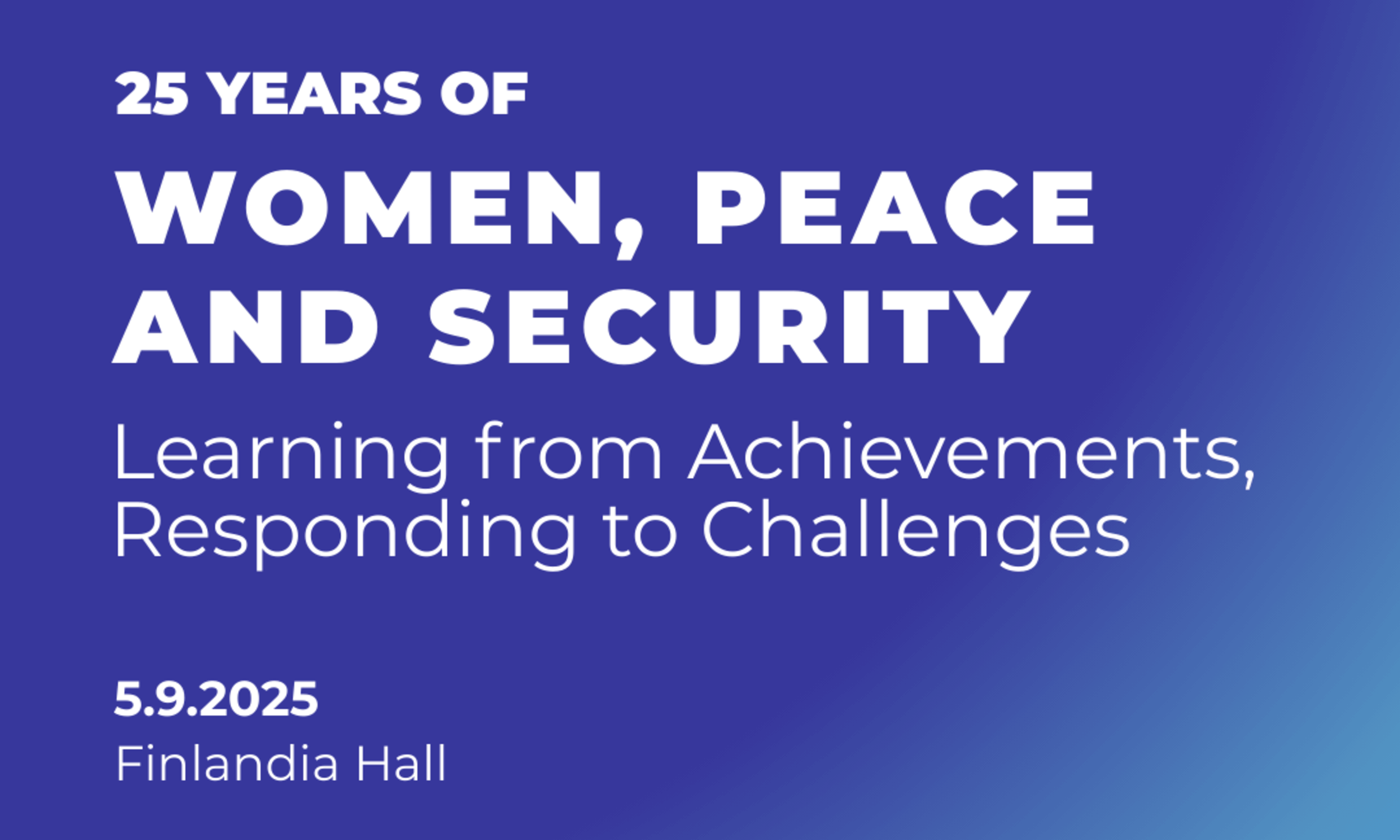
CMI will host a panel at a seminar in Helsinki on 5 September to mark the 25th anniversary of UN Security Council Resolution 1325. ‘Women, Peace and Security at 25 – Learning from Achievements, Responding to Challenges’ gathers Finnish and international leaders, experts and civil society actors to reflect on the resolution’s achievements and the current challenges the agenda faces.
Seminar: practical details
Title: Women, Peace and Security at 25 – Learning from Achievements, Responding to Challenges
Time and date: 8.15–11.30, Friday 5 September 2025
Location: Finlandia Hall, Helsinki, Finland
Register for livestream or physical attendance by Wednesday 3 September
25 years of UN Security Council Resolution 1325
A seminar jointly organised by the Finnish Women, Peace and Security Network, the Ministry for Foreign Affairs of Finland, CMI – Martti Ahtisaari Peace Foundation, CMC Finland, and the Finnish Council for Gender Equality (Tane) will take place on Friday 5 September 2025 at Finlandia Hall in Helsinki.
The event marks the 25th anniversary of UN Security Council Resolution 1325 on Women, Peace and Security (WPS). The resolution, adopted in 2000, was the first to recognise how conflicts disproportionately affect women, whilst also emphasising the importance of women’s equal and meaningful participation in peace processes.
Women, Peace and Security at 25 – Learning from Achievements, Responding to Challenges brings together national and international experts, policymakers and civil society to discuss how to advance the WPS agenda in today’s challenging security environment.
The programme, which starts at 8.15, will be conducted in two parts: the first in English, followed by the second in Finnish (no simultaneous interpretation). The event includes three separate panels exploring different dimensions of the WPS agenda.
The seminar will feature high-level remarks, including:
- Welcome remarks: Elina Korhonen, Chair of the Finnish Women, Peace and Security Network
- Opening words: Outi Holopainen, Under‑Secretary of State for Foreign and Security Policy, Ministry for Foreign Affairs of Finland
- Keynote speech: Tarja Halonen, former President of Finland
- Speech: Kaari Mattila, Professor of Practice at the University of Eastern Finland, Secretary‑General of the Finnish League for Human Rights, and first Chair of the Finnish Women, Peace and Security Network
- Speech: Karoliina Partanen, Chair of the Finnish Council for Gender Equality (Tane)
The anniversary seminar offers an opportunity to review achievements and identify remaining gaps in advancing women’s equal participation and protection throughout conflict and peace processes.
CMI’s panel discussion
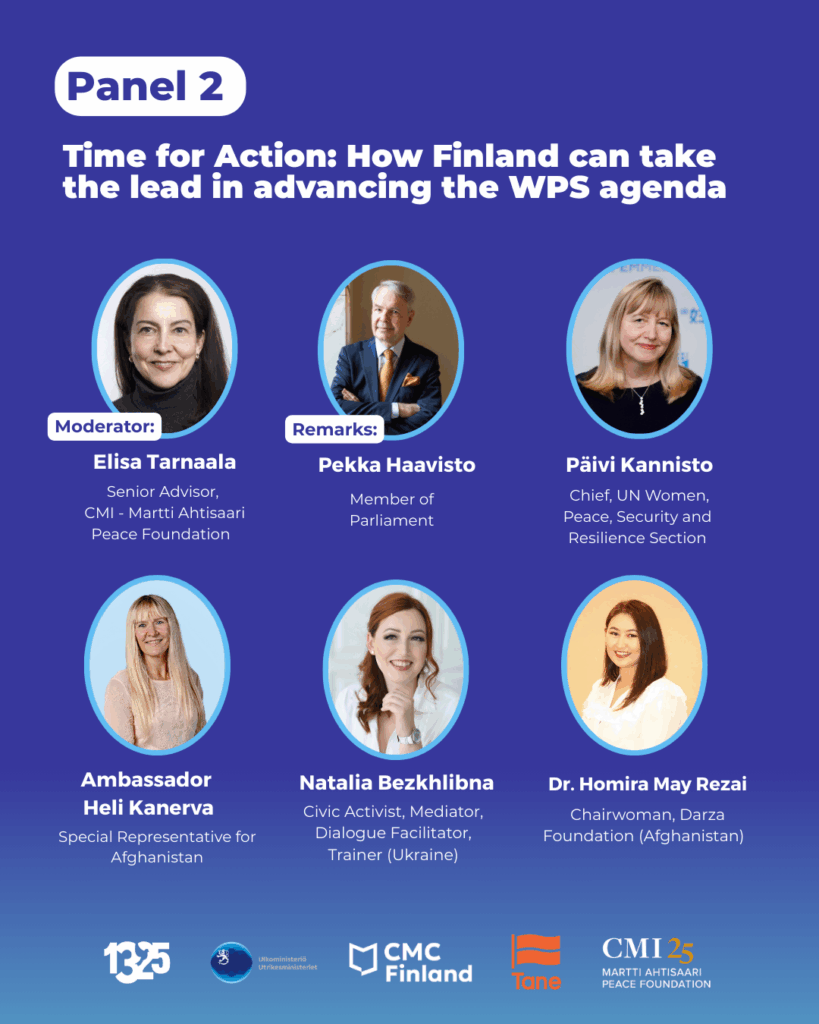
CMI will host a panel discussion entitled: How can Finland take the lead in advancing the WPS agenda?
The discussion will reflect on real opportunities and challenges for women, peace and security within current foreign and security policy contexts. The discussion draws on the panellists’ first-hand experiences of women’s roles in peace efforts and the obstacles to implementing WPS commitments in conflict settings.
The panellists are:
- Natalia Bezkhlibna, Strategic Development Director and Peacebuilding Initiatives Advisor for the Ukrainian Community of Dialogue Practitioners
- Homira May Rezai, CEO of Education Bridge for Afghanistan and Director of Advocacy at Bolaq Analyst Network
- Heli Kanerva, Special Representative and Ambassador of Finland to Afghanistan
- Päivi Kannisto, Chief of the Peace, Security and Resilience Section at UN Women headquarters in New York
The panel will be moderated by Dr Elisa Tarnaala, Senior Adviser at CMI. Pekka Haavisto, Member of Parliament in Finland and former Minister for Foreign Affairs, will serve as commentator of the panel.
CMI’s panel: practical details
Title: How can Finland take the lead in advancing the WPS agenda?
Time and date: 9.50–10.30, Friday 5 September 2025
Location: Finlandia Hall, Helsinki, Finland
Register for livestream or physical attendance by Wednesday 3 September
Panellists
Natalia Bezkhlibna, Strategic Development Director and Peacebuilding Initiatives Advisor for the Ukrainian Community of Dialogue Practitioners
Natalia Bezkhlibna is a seasoned mediator, dialogue facilitator, project designer and leader with a rich background in various fields. With over eight years of experience designing and leading civil society initiatives in Ukraine, she is dedicated to fostering a culture of dialogue and peaceful conflict resolution. Her areas of expertise include peacebuilding, conflict-sensitivity, mediation, public dialogue, conflict transformation, and project leadership.
Homira May Rezai PhD FRSA, British-Hazara scientist and human rights advocate
Homira serves as the CEO of Education Bridge for Afghanistan and Director of Advocacy at Bolaq Analyst Network. She champions intersectional justice, with a focus on Hazara women and other marginalised communities, advocating for their rights through education, policy, and global engagement.
Heli Kanerva, Special Representative and Ambassador of Finland to Afghanistan
At the Ministry for Foreign Affairs of Finland, Ambassador Kanerva has previously served as Special Representative for Mediation and United Nations Resolution 1325, as well as Deputy Director for Security Policy and Crisis Management. She has served twice at Finland’s Permanent Mission to the UN in New York and has also worked at Finnish Embassies in Tallinn and Budapest.
Päivi Kannisto, Chief of the Peace, Security and Resilience Section at UN Women headquarters in New York
Prior to joining UN Women, Päivi worked in the Ministry for Foreign Affairs of Finland as Senior Adviser in Gender Equality. She also worked at CMI and the Office of President Ahtisaari as Project Manager for the Aceh Peace Process as well as Women in Peace Processes projects. Earlier she served various UN entities, including UNDP, UNEP, UNAIDS, UN-OCHA in Ethiopia, Zimbabwe, Kenya and Switzerland in conflict and crisis, as well as in pre- and post-conflict settings, and in coordination and external relations.