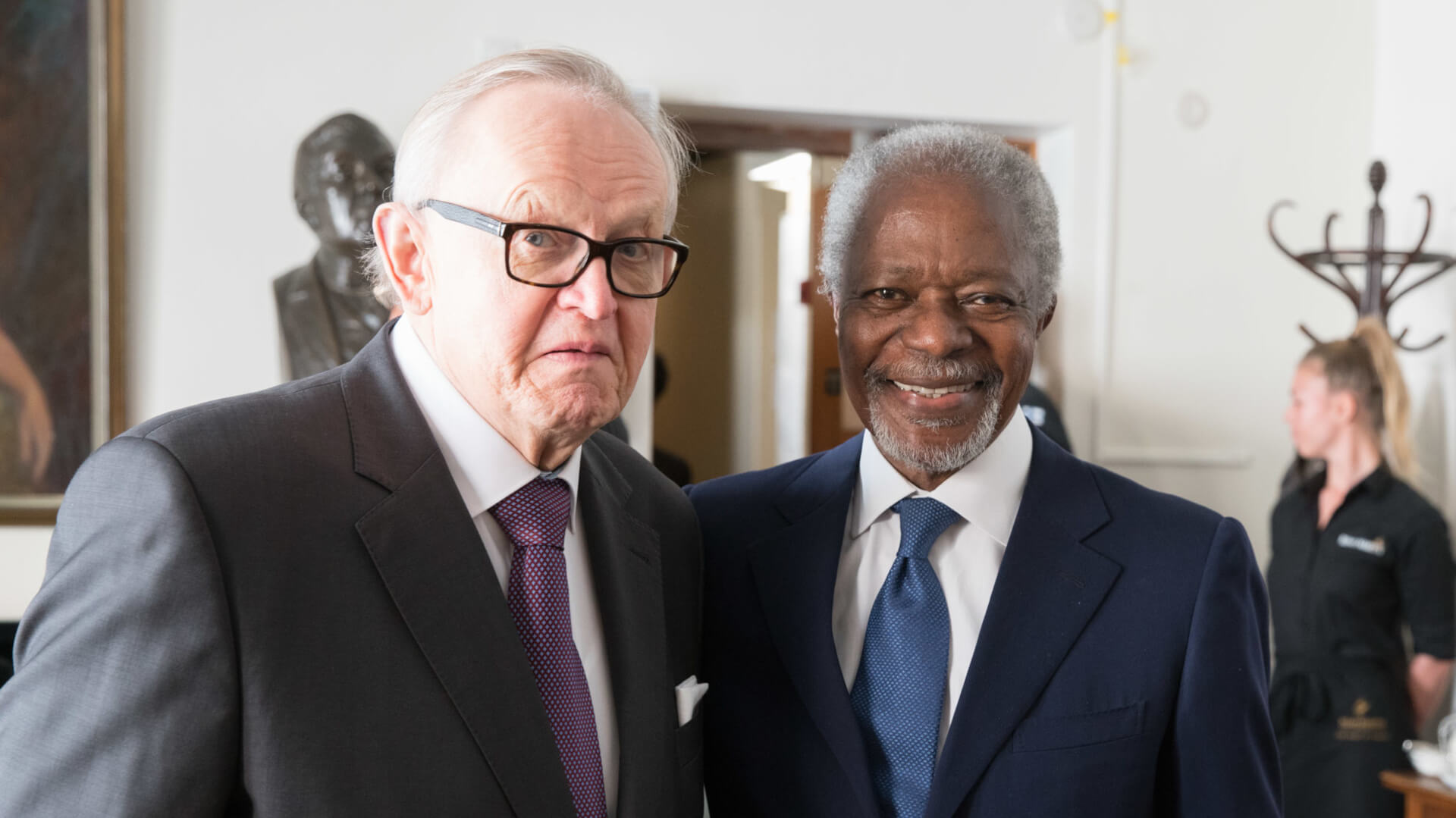
President Ahtisaari and his good friend, former UN Secretary-General Kofi Annan, May 22nd, 2017 at Wisdom Wanted – the Elders and CMI seminar in Helsinki. Photo: Riku Isohella
Martti Ahtisaari (1937-2023) leaves a powerful, living legacy for peace mediation. His core principles are ever more important for advancing peace in an increasingly unstable world.
Martti Ahtisaari, President, Nobel Peace Prize laureate and founder of CMI, passed away on the 16 October 2023, but his example lives on. As Ahtisaari often emphasised, CMI is the most important legacy of his life’s work. In 20 years, CMI has grown into one of the world’s leading peace mediators, continuing the work of its founder around the globe.
Ahtisaari also had a significant impact on the broader development of peace mediation. In 2024, to honor his contributions to the evolution of this field, CMI aims to stimulate discussion on how Ahtisaari’s core principles are relevant to the future of peacemaking.
Ahtisaari’s living legacy is essentially about values and ways of working, of which we now introduce three key principles. All of them continue to guide CMI’s work.
Treat everyone equally
Ahtisaari was known for not making distinctions between people. For him, everyone was on an equal footing. The most important thing in mediation is to try to listen to others and to place yourself in their shoes. Ahtisaari had an extraordinary ability to connect with people.
Peace is not made between friends, but between enemies, and yet every wrongdoer must be treated with respect. Ahtisaari was sometimes criticised for this approach. During the Kosovo peace talks in 1999, Ahtisaari’s colleagues wondered at his courteous treatment of Yugoslav President Slobodan Milošević after the Serb forces had attacked Kosovo on Milosevic’s orders. “My reply to my colleagues was: Milosevic is the president. He must be treated with dignity in order for a solution to come about.”
Ahtisaari’s respect for everyone reflected not only his personality but also his Nordic identity built on equality and justice. For Ahtisaari, these were global values that should belong to everyone.
Ahtisaari often reminded us that without equality, the world will never be free of conflict. That is why a peace process should be inclusive, not only involving elites. Mediation must help build more just societies by means such as improving the position of women and young people and laying the groundwork for a sustainable economy. Ordinary people must benefit from peace.
Ahtisaari’s emphasis on equality is all the more important when burgeoning injustices continue to fuel conflicts around the world. Too often, peace processes are still elite bargains that exclude the wider society. As geopolitical divides become more pronounced, there is also a need to ensure that mediators are able to genuinely talk to everyone.
Parties own the conflict
Ahtisaari often said that there is a tendency to place too much focus on the mediators. “With that we are disempowering the parties to the conflict and creating the wrong impression that peace comes from outside. The only people that can make peace are the parties to the conflict, and just as they are responsible for the conflict and its consequences, so should they be given responsibility and recognition for the peace,” Ahtisaari said in his Nobel acceptance speech.
Ahtisaari emphasised local ownership at a time when it was not actively used in mediation. He understood that peace requires strong will and determination on the part of conflict parties. Mediators are only there to help them. “We can only provide the atmosphere and venue,” Ahtisaari said in the Aceh peace talks. Mediators’ ability to help is based on the trust that the parties have in them and in the process. One has to work to create an atmosphere in which that trust can be born and create incentives for peace.
Strong local ownership increases the chances of sustainable peace. Local ownership has become a magic word in mediation, but its operationalisation leaves a lot to be desired.
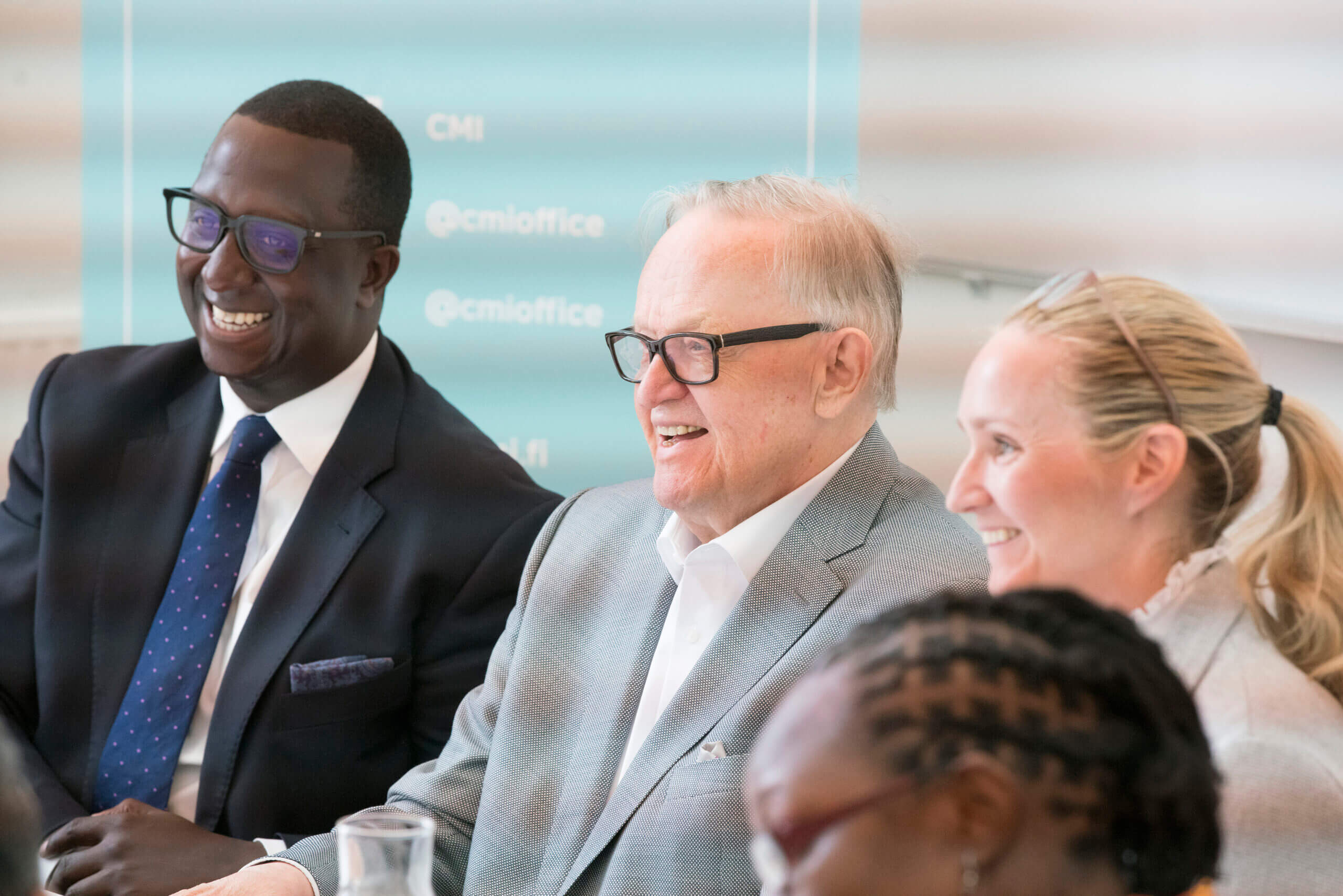
President Ahtisaari joined the Joint Steering Committee of the AU Mediation Support Capacity project in Helsinki in July 2017. Photo: Riku Isohella
You can’t do it alone
”You can’t do a damn thing alone.” This was Ahtisaari’s way of saying that peacemaking is all about teamwork. Ahtisaari often noted that he had always been privileged to work with skilled people. He turned to such colleagues over and over again. “If you imagine you know how to do everything yourself, it’s best to go in for something else,” Ahtisaari remarked.
Successful mediation also requires extensive cooperation in other areas. Peace does not happen in a vacuum; it requires broad support to be realised. Ahtisaari’s work was guided by his ability to cooperate effectively with all those who had an impact on his efforts. He saw clearly how different actors could complement each other in peacemaking.
Key international actors, whether major or regional powers or multilateral organisations, were involved. The commitment of these actors was crucial to the effective implementation and monitoring of the peace agreement, thus providing the necessary support structure to ensure its viability.
During Ahtisaari’s career, international cooperation played a vital role in preventing and resolving conflicts. The United Nations was at the forefront of peacemaking. Ahtisaari was a UN man and continued to strongly believe in the world organisation despite its shortcomings.
Today, the world looks very different. We are witnessing a crisis of multilateralism: the UN and many regional organisations are struggling. The current international system is unable to deal with conflicts. New actors and coalitions are emerging to fill the gap.
Ahtisaari’s spirit of cooperation remains highly relevant when considering the types of partnerships needed to address today’s conflicts.
Read more:
Martti Ahtisaari 1937-2023
Major milestones of Martti Ahtisaari’s career
This article was published in CMI’s 2023 annual report.