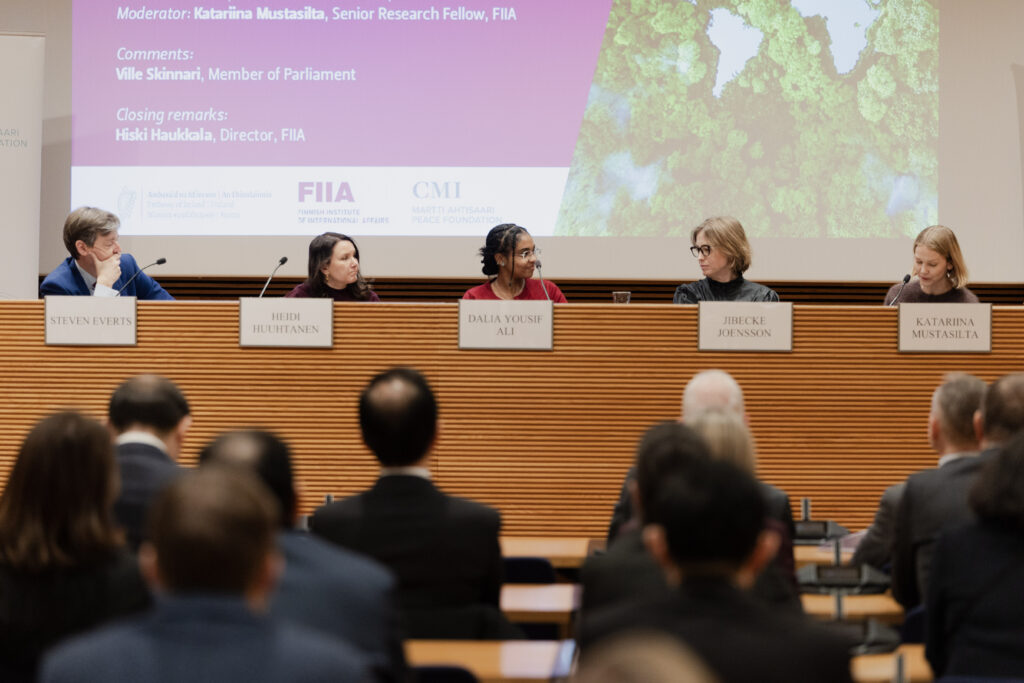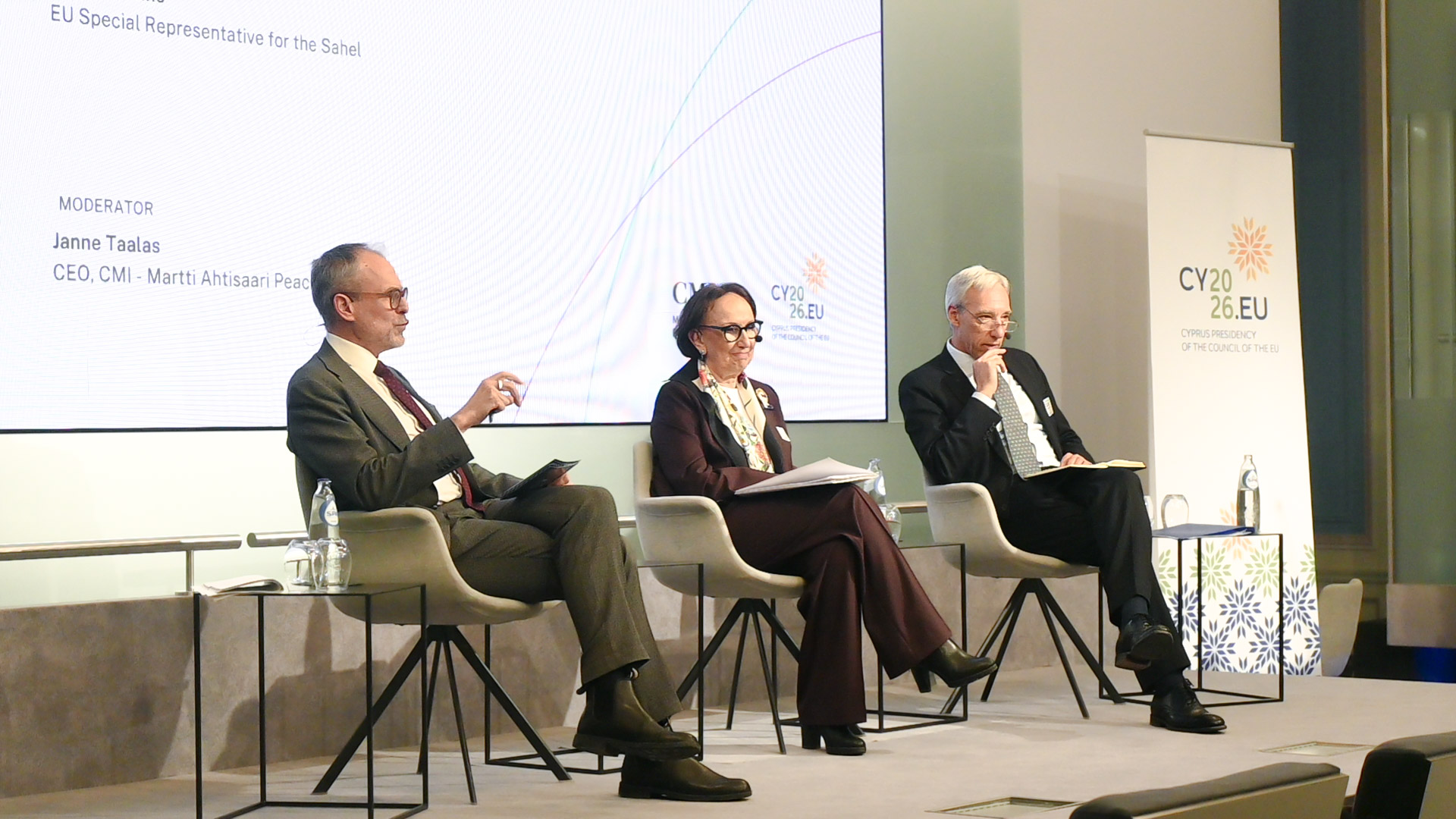
Coinciding with a meeting of global leaders in Davos and an extraordinary summit of EU leaders next door, CMI brought together over 130 policymakers and international leaders in Brussels to grapple with one of the defining questions for the EU and Europe today: how to balance principles and pragmatism for peace.
The fourth edition of the CMI High-Level Dialogue on EU Peacemaking and Principled Pragmatism: Whether and How to go from Political Slogan to Modus Operandi? took place on 22 January 2026, and was organised together with the Permanent Representation of Cyprus to the EU, held under the auspices of the Cyprus Presidency of the Council of the EU.
In a world where “unpredictable” increasingly feels like an understatement, and in which calls for the European Union to adopt principled pragmatism are growing louder, CMI’s 2026 High-Level Dialogue asked some hard but necessary questions:
- What does principled pragmatism really mean in practice?
- What can the EU learn from others?
- And how can this approach strengthen Europe’s ability to prevent and resolve conflict, without losing sight of its values?
The discussion could not have been more timely. Both external shocks and internal pressures are forcing the EU to think more strategically about its role as a global peacemaker, notably when it comes to balancing values and interest in the rapidly changing transactional and fragmented global landscape.
Six points that emerged during the discussions
1) Principled pragmatism is not new, but the debate is more critical than ever
Principled pragmatism is not new to the EU, its foreign policy or to other global actors. But over the last year or so, we have seen world leaders call upon each other with increasing frequency to practice principled pragmatism. The World Economic Forum in Davos threw this into even sharper focus with leaders asking one another to practice principled pragmatism for the benefit of cooperation and engagement.
The question of balancing values and interests is a particularly topical foreign policy issue for the EU, its Member States and key partners at a time when transactionalism is a top priority. This implies important questions about what it means for the EU as a peace actor globally. What is understood by principled pragmatism differs widely and with increasing divergence.
In Europe, for a long time, values and interests have been aligned, with the assumption that increasing prosperity would encourage greater alignment in values among partners over time. It has not happened. Now we are increasingly talking about values and interests separately and even in opposition.
2) Europe’s identity is tied to how it manages principled pragmatism
No single actor has the power to shape the future global order alone, yet there is a risk of losing the capacity for collective action because of political demobilisation. The question of principled pragmatism is really a question of how the EU engages externally, including in complex regions of the world.
The EU cannot defend its interests if it does not engage, but engagement requires clarity of purpose: why it engages, what its interests are, and how far it is willing and able to go. This, therefore, goes to the heart of Europe’s identity as a global actor and poses a significant challenge: if Europe is to navigate this era of profound change, it must be able to combine hard security with soft security.
“If Europe is to navigate this era of profound change, it must be able to combine hard security with soft security.”
3) Peacemaking is centre stage because war is centre stage
As military capacity and armed conflicts become increasingly accepted as instruments of statecraft, the need for realistic channels to de-escalate, contain, and ultimately end wars has grown. The return of war has moved peacemaking to the centre stage, but it has also changed the nature of peace negotiations.
Peacemaking is increasingly shaped by strategic competition and geopolitical signalling. This state of affairs underlines why diplomacy is so important, and why we need multilateral cooperation. We see this in how mediation has become a central diplomatic battleground, where not only traditional powers but also rising middle powers and globally active states compete for influence.
In this world of wars and great power politics, the strongest international assets are twofold: credible expertise in peace mediation and credible military capability. The EU must ensure that its credibility in both is maintained. This is not only about international standing. It is also about preventing the further spread of war and the security of Europe. Even in a world shaped by conflict, we must do everything possible to push war back to the margins of international politics. The question is whether Europe wants to and can shape this space, and if yes, then how.
“Traditional powers, rising middle powers and globally active states compete for influence.”
4) For peacemaking to be a credible solution, pragmatism is essential
Peace is strained, conflicts are protracted, and multilateralism is under doubt. This raises the question of how peacemaking can remain credible, which leads us to principled pragmatism. It reflects the dilemma of how to preserve human dignity and legitimacy in peacemaking while adapting pragmatically to today’s realities.
In peacemaking, some argue that relying solely on principles is inefficient, while purely pragmatic approaches risk lacking sustainability. Effective and lasting outcomes require a balance of both, grounded in reality, supported by honest discourse, flexibility, and sensitivity to context. Principles and pragmatism are essential; one without the other will not work.
“The EU cannot defend its interests if it does not engage, but engagement requires clarity of purpose: why it engages, what its interests are, and how far it is willing and able to go.”
5) Principled pragmatism is an antidote to short-termism
Principled pragmatism is increasingly stressed by both EU decision-makers and partners. It does not represent transactionalism or short-term opportunism, but offers a path to strategic autonomy. Underpinning the approach is the belief that non-engagement is not an option. It is an approach that has been central for the EU to overcoming dictatorships and supporting transitions to democracy.
In certain case examples brought forward in the discussion, progress in peace processes required flexibility alongside firm principles. Moving from military repression to democratic governance is inherently difficult and cannot succeed through rigid approaches alone. In sum, these experiences show that principled pragmatism means navigating complex political transitions while remaining anchored in core values.
“It does not represent transactionalism or short-term opportunism, but offers a path to strategic autonomy.”
6) How we define principle-led pragmatism is contested
There are several points of tension in the EU around principled pragmatism. Member States are increasingly accused of acting too pragmatically while the EU is criticised for insisting on principles. Without convergence between the two, the EU is weakened. In the European Parliament, there is strong emphasis on principles, but many say with insufficient pragmatism. What is clear, is that the two must be integrated.
Peace is both an interest and a value. At times, this balance is wrong in the EU. When we overemphasise principles, we are reminded that they are not applied consistently everywhere. For principled pragmatism to work, conditions such as these must be met: i) Clear interest, including political and economic investment; ii) Relevant instruments capable of making a difference – without them, there is no impact; iii) Sufficient convergence and unity within the EU. In some cases, the EU has clear interests, relevant tools, and sufficient unity. In other regions, the picture is more mixed and evolving.
Principled pragmatism requires acknowledging political realities and local power structures without endorsing them. Engagement does not mean, for example, legitimising paramilitary forces; it means understanding and navigating the context in order to pursue peace and stability. Principled action must sometimes be balanced with urgent practical realities.
Principled pragmatism becomes meaningful only if it is operationalised rather than treated as a slogan, requiring careful engagement with difficult trade-offs and normative clarity.
“Principled action must sometimes be balanced with urgent practical realities.”