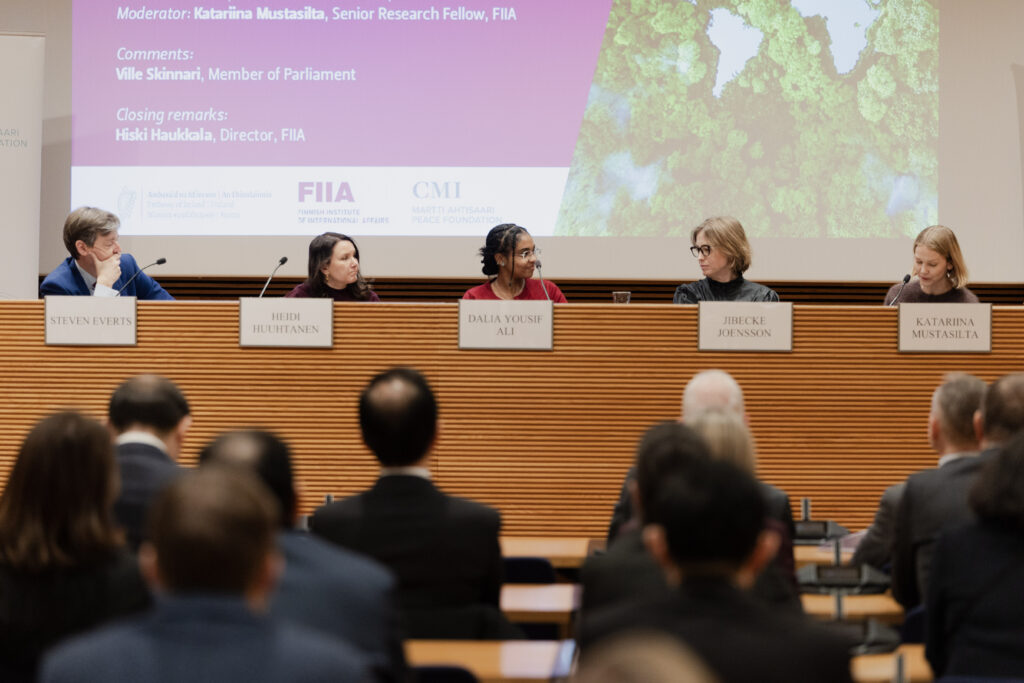
The 2025 and 3rd edition of the CMI Brussels High Level Dialogue took place in Brussels on 30 January, co-organized with the Polish Presidency of the Council of the EU and the Spanish Ministry of Foreign Affairs.
More than 130 leaders, policy-makers and experts came together to reflect on Peacemaking Efforts and Shrinking Diplomatic Space, deliberating on where and what is dialogue in the EU’s Common Foreign and Security Policy?

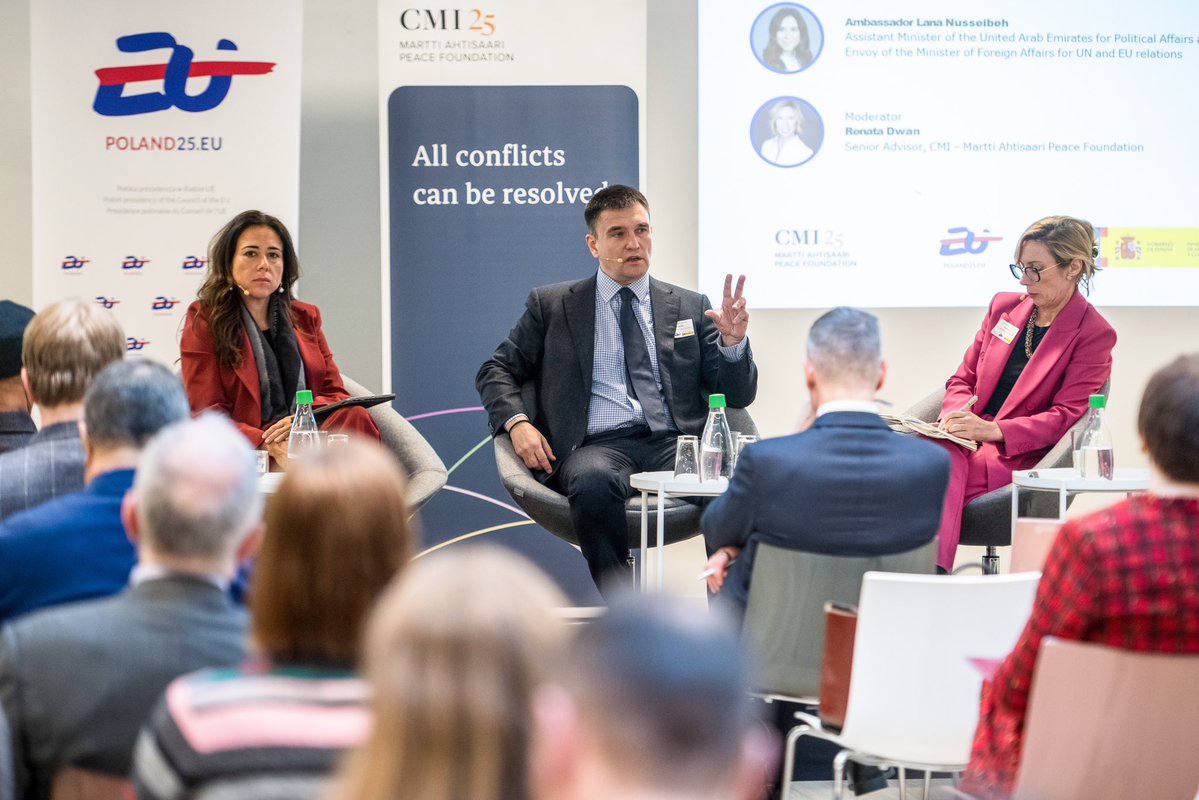
Ambassador Lana Nusseibeh, Assistant Minister of the United Arab Emirates for Political Affairs and Envoy of the Minister of Foreign Affairs for UN and EU relations; Ambassador Pavlo Klimkin, Former Minister of Foreign Affairs of Ukraine. Moderated by Renata Dwan, Senior Advisor, CMI – Martti Ahtisaari Peace Foundation. Picture: Polish Presidency of the Council of the EU.
In an increasingly fragmented geopolitical environment, multilateralism is waning and formal spaces to resolve conflict are shrinking. This poses important challenges for EU peacemaking, but it also presents opportunities for rethinking how the EU promotes and supports peace worldwide.
With the U.S. role in international diplomacy uncertain, the EU’s engagement is more crucial than ever. There is no doubt that the EU must act decisively to face today’s challenges around the world. The EU must recognize its own agency and the influence it can have on global developments.
As the international landscape is reshuffling, there is an opportunity for the EU to build strategic partnerships with a wider range of partners, balancing pragmatism with principles. This extends beyond actors who are excluded, to actors who do not want to be included. Speakers all stressed how this requires the EU to enhance and diversify global connectivity. Exploring the concept of creative diplomacy and acting with agility will be key to generating results.
By collaborating and creating consensus on issues of common interest, such as maritime security or environmental protection, trust can be built. (Re)discovering that even the most unlikely of partners can have common goals, multilateralism can be revitalized. However, when doing so, the EU must be aware of how in the current context, its engagement outside of Europe risks being viewed through the lens of double standards, with concerns over the selective application of international law. The EU must straightforwardly address possible doubts about its objectivity and make the European offer increasingly appealing, especially in regions where emerging geopolitical actors’ rising influence threatens the stability of the international rules-based order. This means ensuring that partnerships deliver tangible outcomes that put people at the centre and that are not overly burdened by bureaucracy.
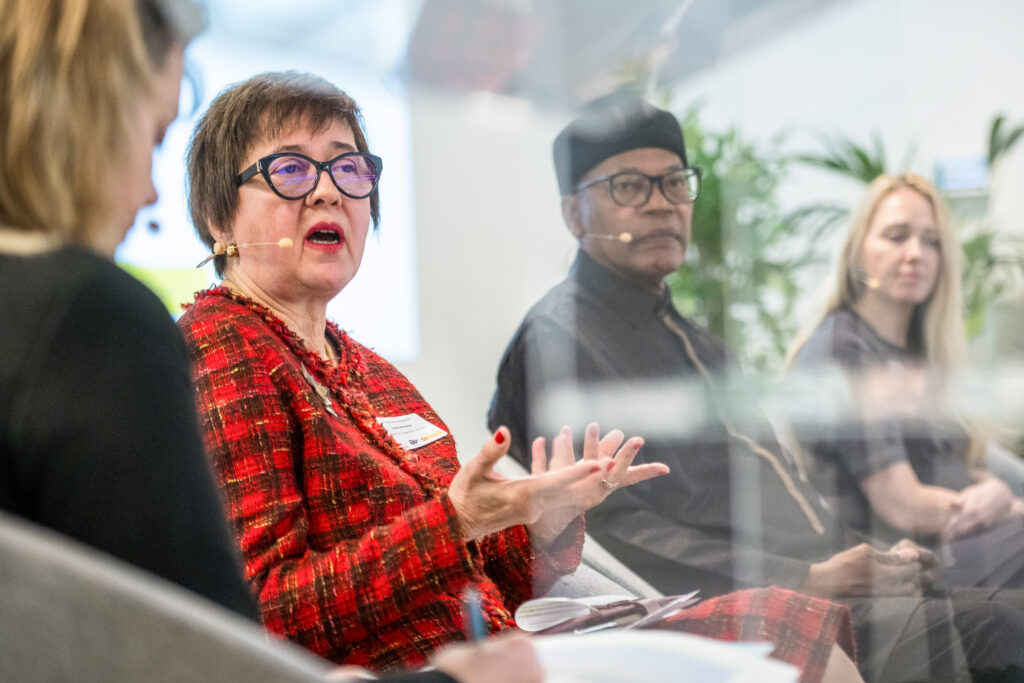
Ambassador Joanna Wronecka, Former UN Special Coordinator for Lebanon; Ambassador Mohamed Ibn Chambas, AU High Representative for Silencing the Guns, Chair of the AU High-level Panel for Sudan; Nina Wilén, Director of the Africa Programme, Egmont Royal Institute for International Relations. Moderated by Marta Martinelli, Nonresident scholar, Carnegie Europe. Picture: Polish Presidency of the Council of the EU.
As new actors enter the international peacemaking stage, the EU needs to focus its efforts in ensuring an “all hands-on deck” approach that pursues the coordination and complementarity of all ongoing peace initiatives. Competing parallel diplomatic efforts can end up further undermining multilateral decision-making and result in inefficient, blindsided engagement. By promoting pragmatic dialogue between all actors involved in a specific conflict or fragile setting, the EU has the opportunity not only to build trust with other actors around the world, but to improve the efficiency of peacemaking initiatives.
While peacemaking has been traditionally tied to multilateral frameworks, the panelists agreed on the potential of regional players and regionally owned solutions, supported by global actors. As the UN struggles to adapt, regional organizations must step up to provide tailor-made solutions in close cooperation with medium-sized powers and mini lateral groupings that can help hold leaders accountable to the agreements made. Panelists agreed on the importance of the Gulf as an emerging hub for mediation and recognized the potential of the EU-GCC partnership to this end.
By diversifying diplomatic engagement and providing targeted support, the EU can become a key player in regional stability efforts. There is an opportunity for the EU to take the lead in the creation of new spaces for dialogue by investing in regional mechanisms based on regional principles and approaches, with local stakeholders at the centre. This requires exploring ways in which to ensure the effective inclusion civil society actors (including in Track 1 efforts), with particular focus on women and youth.
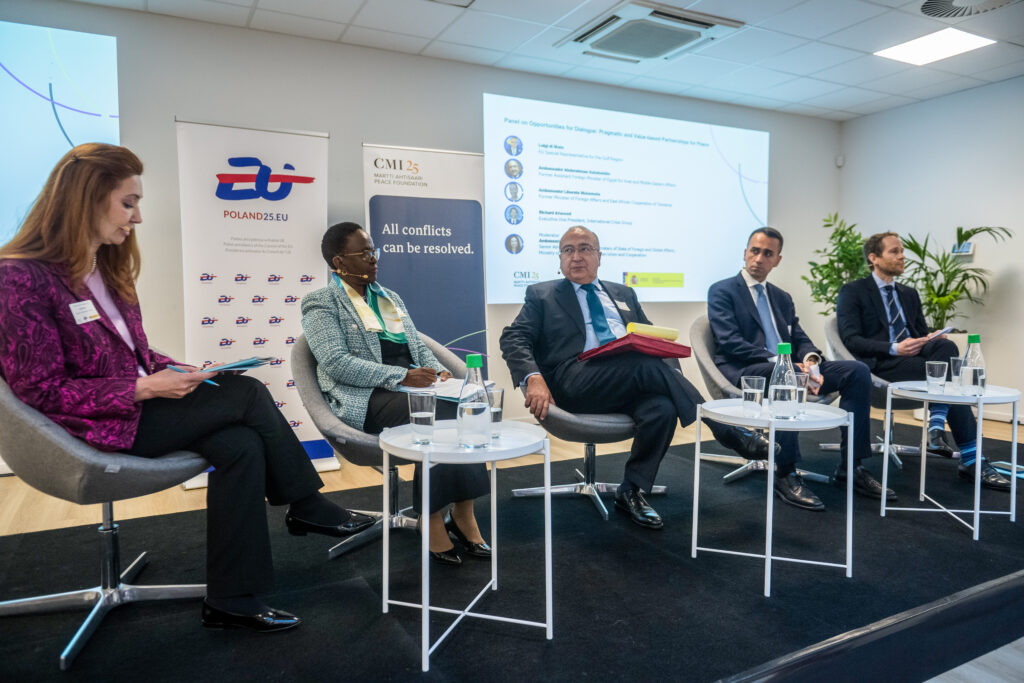
Ambassador Liberata Mulamula, Former Minister of Foreign Affairs and East African Cooperation of Tanzania; Ambassador Abderahman Salaheldin, Former Assistant Foreign Minister of Egypt for Arab and Middle Eastern Affairs; Luigi di Maio, EU Special Representative for the Gulf Region; Richard Atwood, Executive Vice President, International Crisis Group. Moderated by Ambassador Belén Alfaro, Senior Adviser, Cabinet of the Secretary of State of Foreign and Global Affairs, Ministry of Foreign Affairs, European Union and Cooperation. Picture: Polish Presidency of the Council of the EU.
To take a lead in tackling the crisis of confidence from which the current world is suffering, the EU must set clear priorities and cohesive approaches and strategies. These must be clearly communicated in public discourse to counter misinformation and enhance strategic communication with more effective messaging.
The EU’s strength depends on Member States’ willingness to cooperate and compromise and its ability to promote its interest at the global level is shaped by where, with whom and how the EU engages with partners.
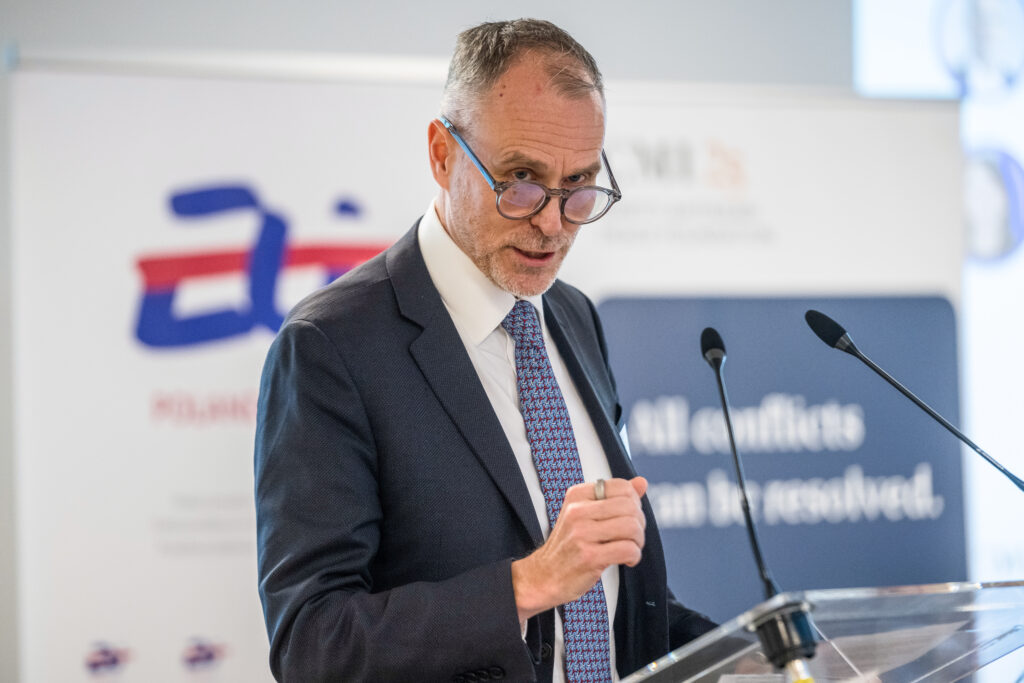
Janne Taalas, CEO, CMI – Martti Ahtisaari Peace Foundation. Picture: Polish Presidency of the Council of the EU.
For more information on the programme of the 2025 edition of the CMI Brussels High-Level Dialogue on Peacemaking Efforts and Shrinking Diplomatic Space, kindly see here. You can also access the LinkedIn publication summarizing some key takeaways of the discussions here.